Prostacyl Official Website › Blog › Lycopene 5%
What “Lycopene 5%” Actually Means On A Supplement Label
A percentage printed in front of a weight quietly changes what the weight means. Ten milligrams becomes half a milligram, and the row goes from looking generous to looking thin without a single number changing.
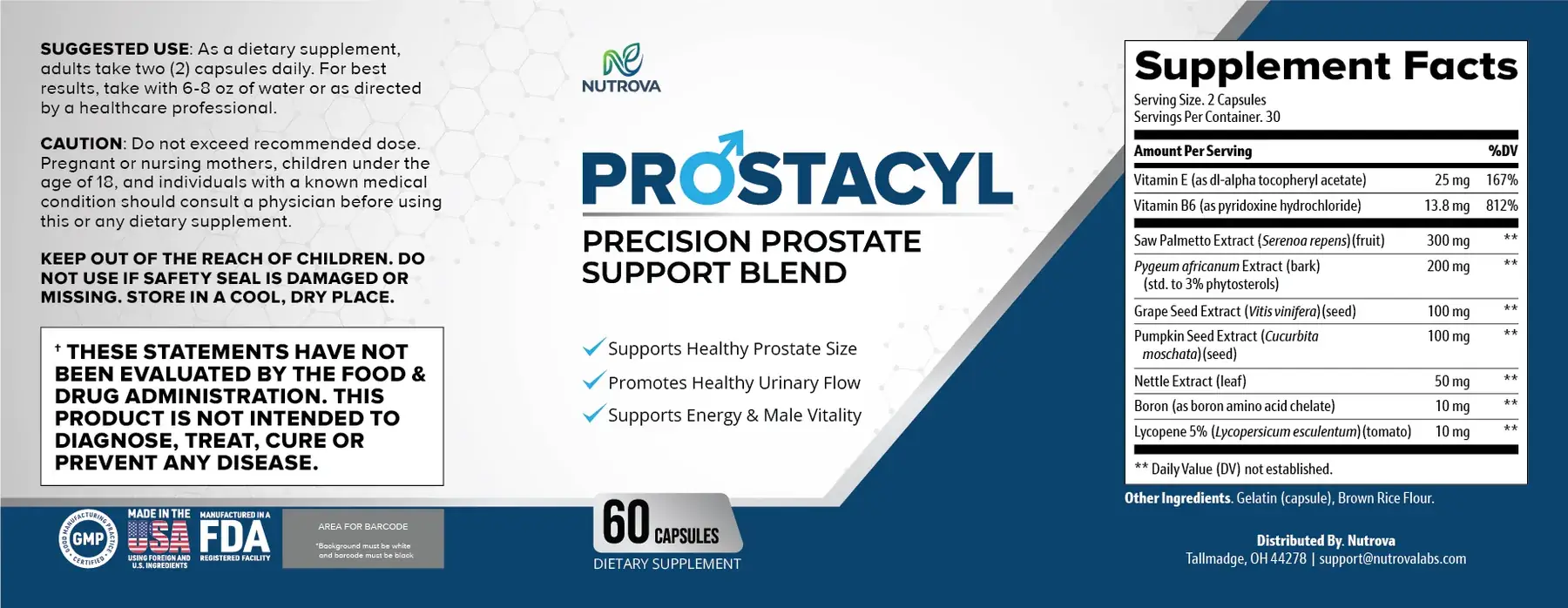
- On the standard reading, 10 mg of a 5% lycopene preparation supplies about 0.5 mg of lycopene.
- The only randomised trial in benign prostatic hyperplasia used 15 mg a day in 40 men over six months.
- The Cochrane review found three randomised trials totalling 154 participants, no significant PSA difference, and two of the three at high risk of bias.
- The FDA reviewed the evidence itself and concluded there was no credible support for a lycopene and prostate cancer claim.
- A percentage is not automatically a warning sign. The pygeum row on this same panel carries one and reads well.
Why a percentage changes the arithmetic
Most rows on a Supplement Facts panel are a name followed by a weight, and the weight is the whole story. Vitamin E at 25 mg is 25 mg of the named compound. Boron at 10 mg is 10 mg of elemental boron.
A standardised botanical row works differently. The weight describes the material in the capsule, and the percentage describes how much of the interesting compound is inside that material. Multiply the two and you get the amount that matters.
Ten milligrams at five per cent is half a milligram. That single multiplication is the whole of the arithmetic, and it is the step almost nobody takes at the shelf.
| If the row means | Lycopene it supplies | Against the 15 mg used in the one BPH trial |
|---|---|---|
| 10 mg of a 5% preparation | About 0.5 mg | Roughly a thirtieth |
| 10 mg of a 10% preparation | About 1 mg | Roughly a fifteenth |
| 10 mg of pure lycopene | 10 mg | Two thirds |
| 300 mg of a 5% preparation | 15 mg | The trial amount exactly |
The first line is the standard industry reading of a row written as “Lycopene 5% ... 10 mg”. The last line shows what a 5% material would have to weigh to reach the trial figure.
The last line of that table is the one that puts the scale in perspective. To reach the amount used in the one trial in this indication, a five per cent preparation would have to weigh 300 mg, which is the size of the saw palmetto row rather than the lycopene row.
Where a 5% material comes from
Lycopene is the carotenoid that makes tomatoes red. It is fat-soluble, poorly absorbed from raw fruit, and extracted commercially as an oleoresin from tomato pulp or produced by fermentation.
Raw oleoresin is not a convenient powder, so suppliers stabilise it onto a carrier and sell it at a declared strength. Five, six and ten per cent beadlets are all ordinary trade grades, and the strength a capsule maker buys is what ends up printed in the ingredient name.
So “Lycopene 5%” is not obfuscation. It is the trade description of the raw material, reproduced on the label. The difficulty is that it reads as part of the ingredient’s name rather than as a divisor.
The other way that row could be read
The alternative reading belongs on the table, because it exists and some labels do mean it.
- The standard reading. The weight describes the raw material and the percentage describes its strength, so 10 mg of a 5% preparation supplies about 0.5 mg of lycopene.
- The minority reading. A few manufacturers intend the weight to describe the compound delivered from a 5% source, which would make it 10 mg of lycopene and put the row at two thirds of the trial amount.
This desk uses the first for two reasons. It is the convention across the supplement trade, and it is what the row as written says: the material is the thing being weighed, and the material is five per cent lycopene. A buyer who wants certainty can ask the seller for the raw material specification, which is a fair question to put to any brand carrying a standardised row.
The single trial in urinary symptoms
Lycopene has been studied for prostate health for three decades, but the amount of it aimed squarely at urinary symptoms is small. One randomised trial gave 15 mg a day to men with benign prostatic hyperplasia over six months and reported that it slowed progression on the measures it tracked.
Forty men, six months, one trial. That is the entire randomised base for the job this ingredient is on a prostate label to do, and nobody has replicated it at scale.
Against half a milligram, the gap is not a matter of interpretation. Even under the generous reading of the row, the panel sits below the studied amount; under the standard reading it sits a long way below it.
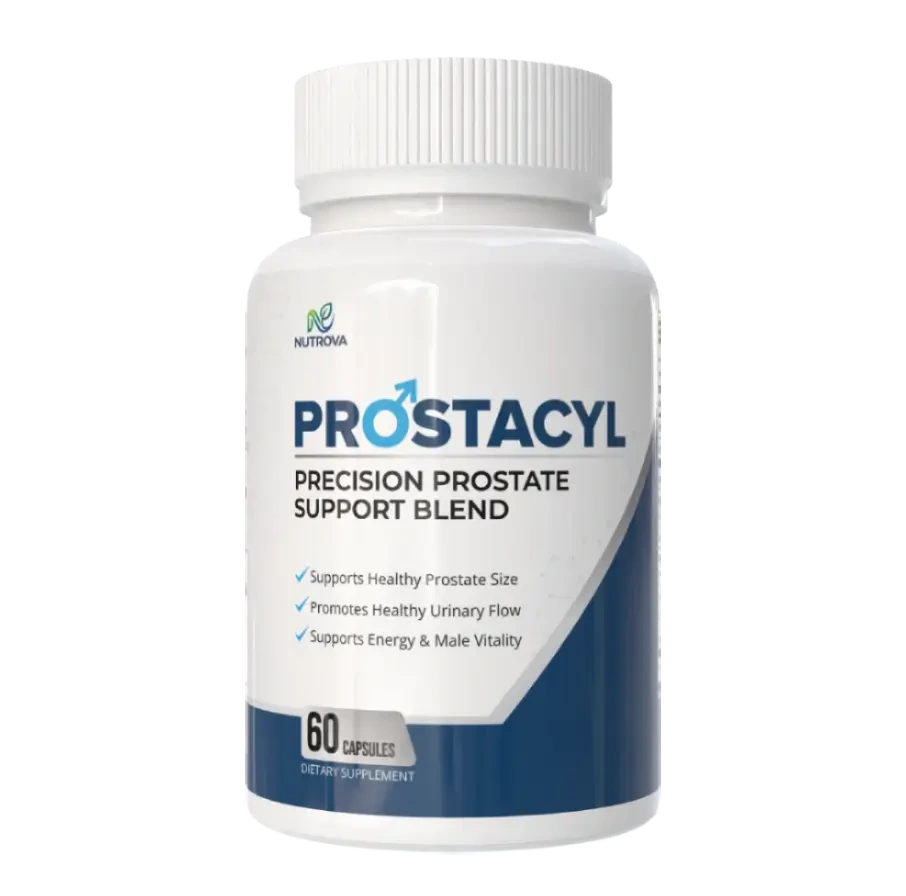
The Prostacyl panel prints all nine numbers
Including the two rows that carry a percentage, which is what makes this arithmetic possible from the outside. Two capsules a day, 60 to a bottle, 60 days to change your mind.
One bottle $69 · six bottles $294 · 60-day money-back guarantee
Order Prostacyl On The Official WebsiteTwo capsules a day · 60 per bottle · lot PRO-26/GE-3008
The cancer question, and the FDA’s own answer
Lycopene reached the public through cancer headlines rather than through urinary symptoms, and that history needs stating carefully because the regulator has already ruled on it.
The FDA’s published evidence review examined the petitions for qualified health claims linking tomatoes, lycopene and cancer and concluded there was no credible evidence to support a lycopene and prostate cancer claim. That is the agency’s own scientists, reviewing the same literature everyone else cites, and declining.
The Cochrane review reached the same place from a different direction. It found three randomised trials with 154 participants between them, no significant difference in prostate-specific antigen between lycopene and control, and judged two of the three to be at high risk of bias.
No dietary supplement may claim to prevent or reduce the risk of any cancer, and this one does not. The bottle claims support for healthy prostate size, healthy urinary flow, and energy and male vitality. Where a regulator has looked at a specific claim and declined it, repeating the claim in softer words is the same claim.
The other percentage on this panel
It would be easy to leave this with a rule that a percentage on a label is bad news. That rule would be wrong, and the counter-example sits four rows up the same panel.
The pygeum row reads “Pygeum africanum Extract (bark), std. to 3% phytosterols” at 200 mg. The percentage there is a standardisation marker rather than a dilution: it tells you what the extract is guaranteed to contain, and the 200 mg is a weight of extract that lines up directly with the weights used in the trials.
And those trials used less. The dosing study set 50 mg twice a day against 100 mg once a day and found the two performing alike, which puts the researched amount at 100 mg a day. This panel carries double it. That is the label at its best, and it belongs in the same article as the row that is at its weakest.
| Row as the panel prints it | The number in front | What that number is doing |
|---|---|---|
| Pygeum africanum Extract (bark), std. to 3% phytosterols — 200 mg | 3% | Names the marker the extract is standardised to |
| Lycopene 5% (Lycopersicum esculentum) (tomato) — 10 mg | 5% | Names the strength of the preparation |
| Vitamin E (as dl-alpha tocopheryl acetate) — 25 mg | 167% DV | A labelling reference, and nothing to do with strength |
| Saw Palmetto Extract (Serenoa repens) (fruit) — 300 mg | None | A weight of extract, with the concentration left open |
Four rows off the same panel, carrying three different kinds of number. Reading them as if they were the same kind is the commonest mistake made with a Supplement Facts table.
Four rows, three different kinds of number. Anyone who can tell them apart can read any panel in this category, which is a more useful skill than any verdict about one brand.
The antioxidant argument has already been tested once
The reasoning that puts lycopene on a prostate label is an antioxidant one, and this panel runs the same reasoning through vitamin E. It is worth knowing how that has gone.
SELECT gave 35,533 men 400 IU a day of synthetic vitamin E, the same chemical family as the dl-alpha tocopheryl acetate four rows up this panel, and recorded a statistically significant rise in prostate cancer risk. The dose was many times the 25 mg printed here, so nobody should read harm into this bottle from it.
The comfortable assumption underneath the whole antioxidant case is what it removes. More of an antioxidant is not automatically better for a prostate, and the largest trial ever run on the question found the effect pointing the wrong way.
Reading any standardised row in thirty seconds
This is a portable skill, and it works on any bottle on any shelf.
- Find the percentage. It may sit inside the ingredient name, as here, or after a comma as a standardisation.
- Ask whether it is a dilution or a marker. “Lycopene 5%” is a strength; “std. to 3% phytosterols” is a guarantee about a named class of compound.
- If it is a strength, multiply it by the weight. That product is the number worth carrying.
- Look up what the trials used, in the same units. A milligram of compound is comparable only with a milligram of compound.
- Ignore the % Daily Value column for anything botanical. There is no Daily Value for lycopene, which is why that column carries a dagger on seven of these nine rows.
Where lycopene is genuinely easy to get
Nothing above says lycopene is useless. It says the amount in this row is small and the clinical case for supplementing it is thin, which are different claims.
Lycopene is unusual among plant compounds in that cooking makes it more available rather than less. The everyday sources clear this row without trying:
- Tomato paste. A couple of tablespoons comfortably exceeds the amount in this row.
- Tinned tomatoes, passata and cooked tomato sauces.
- Watermelon, pink grapefruit and guava, in smaller amounts.
- Any of those eaten with fat in the same meal, which is what carries a fat-soluble carotenoid across the gut wall.
That is a dietary observation rather than a health claim, and it is worth knowing before paying for a carotenoid by the milligram. The who-it-suits page takes the same approach to the rest of the panel.
What this row is doing on the bottle
A fair verdict has three parts:
- The row is small. About half a milligram of lycopene on the standard reading.
- Its clinical case is thin. One small randomised trial in this indication, and a regulator that reviewed the cancer literature and declined the claim.
- The label told you enough to work both of those out. A panel reading simply “tomato extract” would have left nothing to check; this one printed a strength, a species, a plant part and a milligram figure.
Weigh it as one of nine. The ingredients page runs the same treatment across the whole panel, and the reviews page does it to the distributor’s own review figures.
Nothing written above suggests that lycopene, or Prostacyl, changes prostate cancer risk in either direction; the regulator reviewed that question and declined the claim. This is a dietary supplement for healthy adult men, 18 and over, with no FDA approval. Screening decisions belong with a clinician rather than with a panel.
References
- Schwarz S, Obermuller-Jevic UC, Hellmis E, et al. Lycopene inhibits disease progression in patients with benign prostate hyperplasia. J Nutr. 2008;138(1):49-53. PMID 18156403. https://pubmed.ncbi.nlm.nih.gov/18156403/
- Ilic D, Forbes KM, Hassed C. Lycopene for the prevention of prostate cancer. Cochrane Database Syst Rev. 2011;2011(11):CD008007. PMID 22071840. https://pubmed.ncbi.nlm.nih.gov/22071840/
- Kavanaugh CJ, Trumbo PR, Ellwood KC. The U.S. Food and Drug Administration's evidence-based review for qualified health claims: tomatoes, lycopene, and cancer. J Natl Cancer Inst. 2007;99(14):1074-85. PMID 17623802. https://pubmed.ncbi.nlm.nih.gov/17623802/
- Chatelain C, Autet W, Brackman F. Comparison of once and twice daily dosage forms of Pygeum africanum extract in patients with benign prostatic hyperplasia: a randomized, double-blind study, with long-term open label extension. Urology. 1999;54(3):473-8. PMID 10475357. https://pubmed.ncbi.nlm.nih.gov/10475357/
- Klein EA, Thompson IM Jr, Tangen CM, et al. Vitamin E and the risk of prostate cancer: the Selenium and Vitamin E Cancer Prevention Trial (SELECT). JAMA. 2011;306(14):1549-56. PMID 21990298. https://pubmed.ncbi.nlm.nih.gov/21990298/