Prostacyl Official Website › Prostate supplement guide
Prostate supplement guideProstate Supplement Guide: What The Evidence Shows
By the Prostacyl Team at Getprostacyl · Medical review: Dr. Jason Hafron, MD · Revised
Across this category the honest summary is narrow. Pygeum has the most encouraging pooled result and the oldest trials behind it. Saw palmetto has the largest evidence base and a negative modern review at high certainty. Everything else is thinner than the marketing suggests, and no supplement may claim to treat an enlarged prostate.
Ingredient by ingredient, what was actually measured, in whom, and for how long.
The symptoms these products are sold for
What the words mean, and the one step that belongs before a purchase.
The pattern is familiar enough to be a cliche: getting up in the night, a stream that takes its time to start, a longer visit than it used to be. Collectively these are lower urinary tract symptoms, and in men over 50 the commonest driver is benign prostatic enlargement.
Commonest is not only. The same symptoms can come from an infection, from bladder problems unrelated to the prostate, from medication, from diabetes and occasionally from something that needs finding early. The American Urological Association guideline exists because the initial work-up separates them, and its 2026 revision covers evaluation in current terms.
None of that work-up is onerous, and MedlinePlus describes the condition and the options in plain language for free. The gap a supplement fits into is narrow: symptoms already assessed, no prescription on the table yet, and an interest in supporting normal function while the situation is watched.
Saw palmetto: the most studied, and the most disappointing
The largest evidence base in the category, and what the best-conducted parts of it found.
Serenoa repens is the ingredient this category was built on, and it appears in almost every blend at 320 mg a day, the amount European trials standardised on decades ago.
The modern verdict is unwelcome. The 2023 Cochrane review pooled 27 studies covering 4,656 men and concluded, at high certainty, that it provides little to no benefit for urinary symptoms. Two large NIH-funded American trials agree: a year on the ingredient in STEP looked like a year on placebo, and CAMUS pushed the daily amount as high as 960 mg without the arms coming apart.
One counter-argument is worth stating. Extracts are not interchangeable, and a 2018 review of one specific hexanic preparation reached a more favourable conclusion than the pooled literature does. Whether the preparation explains the difference is the live question here, and it is why a label naming only the species and the amount tells you less than it appears to.
One widely repeated claim is worth correcting because it changes behaviour: saw palmetto is said everywhere to mask a PSA reading. The pre-specified analysis inside CAMUS found no effect on serum PSA beyond placebo even at 960 mg a day, and NCCIH agrees. Unlike finasteride, it does not appear to interfere. Telling a clinician what you take remains sensible.
Pygeum: the most encouraging result, and the oldest
What eighteen pooled trials found, and the three reasons to hold the finding loosely.
Pygeum africanum is bark from an African cherry tree and carries the best pooled outcome this category has produced. A meta-analysis of eighteen randomised trials in 1,562 men found men taking it roughly twice as likely to report overall improvement, with nocturia down about 19 per cent and peak flow up about 23 per cent.
The weakness is the trials rather than the result. They averaged 64 days and only one reported concealed allocation. The Cochrane review covering the same body of work says so and calls for larger, longer studies that have never arrived.
The dose is unusually well pinned down for a botanical. A randomised comparison of once and twice-daily dosing found 100 mg a day effective, which gives a buyer an actual number to hold a label against.
The useful part is the bark, so a label naming the plant without the part is not telling you what you bought; a 2023 review of Prunus africana covers the botany and phytochemistry for anyone who wants the tree rather than the marketing.
Nettle: root and leaf are not the same ingredient
Why two words on a label decide whether an ingredient has any evidence behind it.
This is the distinction most often lost between a research paper and a label. The literature on Urtica dioica splits into two reviews by the same authors: one covering the root, where the prostate evidence sits, and one covering the aerial parts, where it does not.
The proposed mechanism belongs to the root. The lignans said to bind sex hormone binding globulin were isolated from roots in the 1990s, and the human trials follow the chemistry: a placebo-controlled multicentre trial of saw palmetto with nettle ROOT is the kind of study this ingredient is known for.
So “nettle leaf” on a label is a different plant part from the one the research used, and “nettle extract” alone is worse: the reader cannot tell which arrived.
One caution about this literature. The most positive nettle result reported anywhere is a wide outlier whose publication record carries unresolved questions, so it is left out of the citations here. An effect size far outside its own field is a reason to wait for a replication.
Pumpkin seed: the form decides the result
One trial, two forms of the same ingredient, and only one of them worked.
Pumpkin seed is the clearest natural experiment in this category, because one large trial tested two forms of it side by side. GRANU followed 1,431 men for twelve months, with one arm eating 10 g of whole seed a day, one taking 1,000 mg of a seed extract, and one on placebo.
Only the whole seed beat placebo, 58.5 per cent against 47.3 per cent, and the authors called even that provisional. The extract arm did not separate from placebo, at ten times the dose a typical capsule carries.
Elsewhere the evidence is small and mixed: a comparison against prazosin reported favourably on pumpkin seed oil in a study far too small to settle anything. Where a label carries pumpkin seed as an extract, the form with the positive trial behind it is the one you eat by the handful.
Lycopene, vitamin E and the cancer-prevention question
The two ingredients in this category with the biggest gap between reputation and record.
Lycopene, the carotenoid that makes tomatoes red, has been studied here for thirty years. A Cochrane review found three randomised trials totalling 154 participants and no significant PSA difference; the single BPH trial used 15 mg a day in 40 men; and the FDA’s own evidence review found no credible evidence for a lycopene and prostate cancer claim, which is why no label may imply one.
There is a reading trap in the row itself. A label printing “lycopene 5%” beside 10 mg is describing a preparation rather than the carotenoid: that supplies around half a milligram of lycopene against a 15 mg trial dose.
Vitamin E is the cautionary tale of the whole category. SELECT gave 35,533 men 400 IU a day of synthetic alpha-tocopherol and found a statistically significant increase in prostate cancer risk, the opposite of what it was built to show, and a meta-analysis of stroke subtypes found its own trade-off. Supplement amounts sit far below that dose, so the trials do not imply harm at 25 mg; what they remove is any basis for framing vitamin E as prostate support.
Boron, B6 and grape seed: the supporting cast
Three regulars on these panels, and exactly how much sits behind each.
Boron is a trace element with no established human requirement; a review asking whether it is nutritionally relevant at all sums up where the science sits. The prostate evidence is observational and inconsistent, with a case-control study and a later prospective analysis disagreeing. The number to watch is the ceiling: the adult tolerable upper intake is 20 mg a day, so a 10 mg capsule is half of it before anything else counts.
Vitamin B6 is a coenzyme in amino acid and energy metabolism, which is the honest basis for an energy line on a bottle and nothing more. The adult upper intake is 100 mg a day, set because of sensory neuropathy, and a 2023 review notes susceptible people can be affected lower. For prostate size or urinary flow there is no credible human evidence.
Grape seed extract has no human prostate trial. The one BPH-specific study is a 2024 mouse experiment, and the VITAL cohort found an observational association its own authors said should not yet be promoted for prevention. Its randomised human evidence sits in blood pressure instead.
How to read a trial in this category
Three habits that separate a useful study from a quotable one.
Check the length before the result
Urinary symptoms move slowly and most of this literature is short. Six or eight weeks can move a symptom score and tell you nothing about the following year.
Look for the placebo arm, and respect it
The placebo response in these trials is large: scores improve substantially on a dummy capsule, which is why uncontrolled studies and testimonials both look convincing and neither settles anything.
Read what the extract was
Species, plant part, solvent and standardisation all change what is in the capsule, so two products naming the same plant can be different ingredients.
Why “supports prostate health” is the strongest claim allowed
The rule behind the odd phrasing on every bottle in this aisle.
Dietary supplements in the United States are not approved before sale. One may make a structure and function claim, that it supports a normal body function, and may not claim to diagnose, treat, cure or prevent a disease. Benign prostatic hyperplasia is a disease, so no supplement may claim to treat it.
That rule explains most of the strange language in this category. “Supports healthy prostate size” is what a company writes when the sentence it wants is not available to it. The phrasing is the legal ceiling rather than an accident.
The corollary is useful when shopping. Any product promising to shrink a prostate, cure an enlarged one or prevent cancer has stepped outside that ceiling, and a company casual about the claims rule is not a safe bet on sourcing. The FDA declined a qualified claim for lycopene and prostate cancer on the evidence, which is the boundary tested most often.
It also means the interesting question about any of these products is not what it claims. Every label claims much the same thing. It is what is inside, and at what amount.
What all of this means if you are buying
Five conclusions that follow from the evidence above, in the order they matter.
- Get the symptoms assessed once. It answers a different question, and it is cheaper than a year of capsules.
- Judge a blend on its amounts rather than its ingredient count. Nine names on a panel is not nine pieces of evidence.
- Prefer a label that prints every amount, because a proprietary blend cannot be checked against any of the research above.
- Read the plant part and the extract description. They decide whether an ingredient has a literature behind it at all.
- Give any of these two months, and count something at the start so the comparison is a number rather than a memory.
The companion page turns that into seven checks with a pass or fail against each, and applies them to Prostacyl, the product this website sells. It fails two of the seven. The scorecard is here.
Sources cited on this Prostacyl page
The principal records behind this guide. Every other study named above is linked in the sentence that uses it, which is where a citation is worth opening.
- Franco JV, Trivisonno L, Sgarbossa NJ, et al. Serenoa repens for the treatment of lower urinary tract symptoms due to benign prostatic enlargement. Cochrane Database Syst Rev. 2023;6(6):CD001423. PMID 37345871. https://pubmed.ncbi.nlm.nih.gov/37345871/
- Andriole GL, McCullum-Hill C, Sandhu GS, et al. The effect of increasing doses of saw palmetto fruit extract on serum prostate specific antigen: analysis of the CAMUS randomized trial. J Urol. 2013;189(2):486-92. PMID 23253958. https://pubmed.ncbi.nlm.nih.gov/23253958/
- Ishani A, MacDonald R, Nelson D, et al. Pygeum africanum for the treatment of patients with benign prostatic hyperplasia: a systematic review and quantitative meta-analysis. Am J Med. 2000;109(8):654-64. PMID 11099686. https://pubmed.ncbi.nlm.nih.gov/11099686/
- Chatelain C, Autet W, Brackman F. Comparison of once and twice daily dosage forms of Pygeum africanum extract in patients with benign prostatic hyperplasia: a randomized, double-blind study, with long-term open label extension. Urology. 1999;54(3):473-8. PMID 10475357. https://pubmed.ncbi.nlm.nih.gov/10475357/
- Chrubasik JE, Roufogalis BD, Wagner H, et al. A comprehensive review on the stinging nettle effect and efficacy profiles. Part II: urticae radix. Phytomedicine. 2007;14(7-8):568-79. PMID 17509841. https://pubmed.ncbi.nlm.nih.gov/17509841/
- Vahlensieck W, Theurer C, Pfitzer E, et al. Effects of pumpkin seed in men with lower urinary tract symptoms due to benign prostatic hyperplasia in the one-year, randomized, placebo-controlled GRANU study. Urol Int. 2015;94(3):286-95. PMID 25196580. https://pubmed.ncbi.nlm.nih.gov/25196580/
- Kavanaugh CJ, Trumbo PR, Ellwood KC. The U.S. Food and Drug Administration's evidence-based review for qualified health claims: tomatoes, lycopene, and cancer. J Natl Cancer Inst. 2007;99(14):1074-85. PMID 17623802. https://pubmed.ncbi.nlm.nih.gov/17623802/
- Klein EA, Thompson IM Jr, Tangen CM, et al. Vitamin E and the risk of prostate cancer: the Selenium and Vitamin E Cancer Prevention Trial (SELECT). JAMA. 2011;306(14):1549-56. PMID 21990298. https://pubmed.ncbi.nlm.nih.gov/21990298/
- Lerner LB, McVary KT, Barry MJ, et al. Management of Lower Urinary Tract Symptoms Attributed to Benign Prostatic Hyperplasia: AUA Guideline Part I - Initial Work-up and Medical Management. J Urol. 2021;206(4):806-817. PMID 34384237. https://pubmed.ncbi.nlm.nih.gov/34384237/
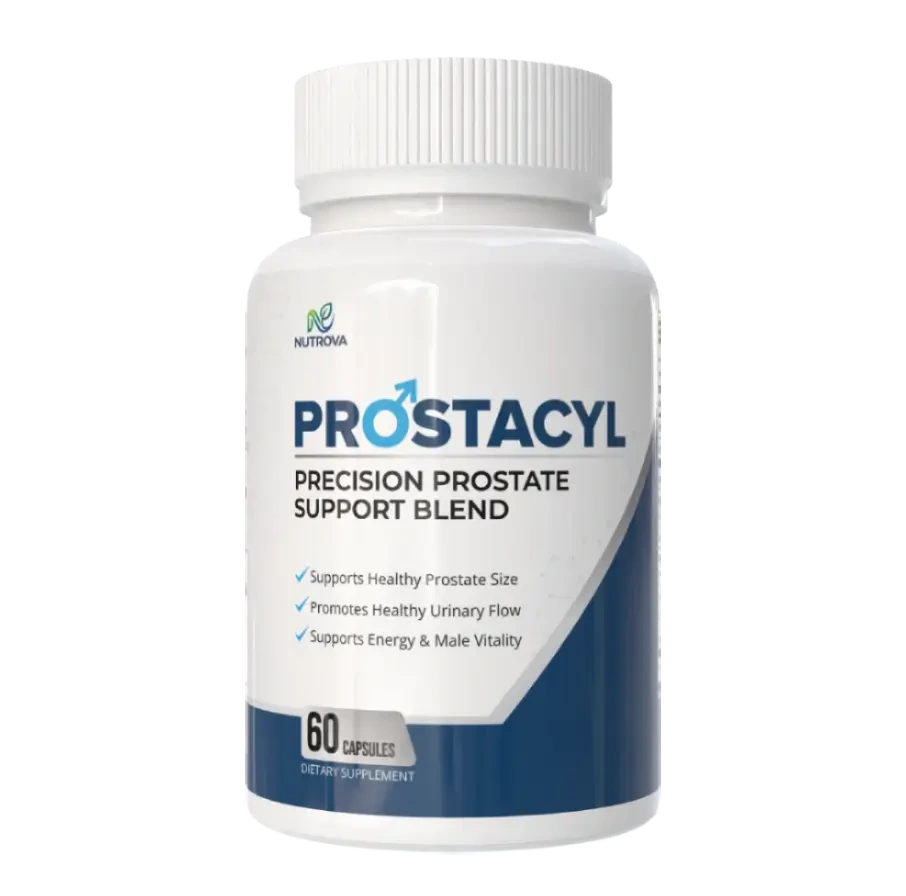
See how Prostacyl reads against this guide
Nine actives, every amount printed, each one set beside the dose its own research used, and 60 days from purchase to change your mind.
One bottle $69 · six bottles $294 · 60-day money-back guarantee
Order Prostacyl On The Official WebsiteTwo capsules a day · 60 per bottle · lot PRO-26/GE-3008