Prostacyl Official Website › Ingredients
IngredientsProstacyl Ingredients: Nine Actives With Printed Amounts
By the Prostacyl Team at Getprostacyl · Medical review: Dr. Jason Hafron, MD · Revised
Prostacyl contains nine actives, and every one has its own printed amount with no hidden blend.
Saw palmetto 300 mg and pygeum 200 mg lead the list, followed by grape seed and pumpkin seed at 100 mg each, nettle leaf 50 mg, vitamin E 25 mg, vitamin B6 13.8 mg, boron 10 mg and lycopene 10 mg.
For the label as printed, see the supplement facts panel.
Every name on the panel, and the amount the research put behind it.
What does the Prostacyl label print?
Nine rows and nine numbers, in the bottle’s own order.
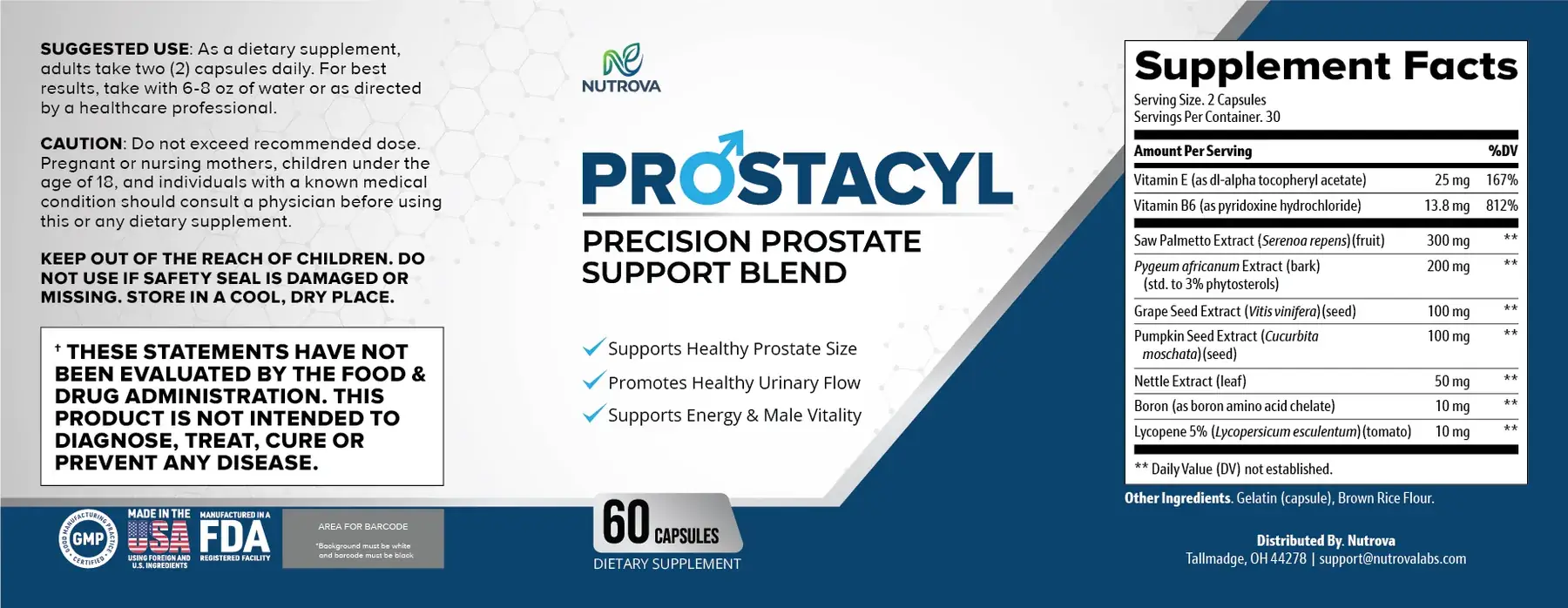
| Row, as printed | Per two capsules | % Daily Value |
|---|---|---|
| Vitamin E (as dl-alpha tocopheryl acetate) | 25 mg | 167% |
| Vitamin B6 (as pyridoxine hydrochloride) | 13.8 mg | 812% |
| Saw Palmetto Extract (Serenoa repens) (fruit) | 300 mg | † |
| Pygeum africanum Extract (bark), std. to 3% phytosterols | 200 mg | † |
| Grape Seed Extract (Vitis vinifera) (seed) | 100 mg | † |
| Pumpkin Seed Extract (Cucurbita moschata) (seed) | 100 mg | † |
| Nettle Extract (leaf) | 50 mg | † |
| Boron (as boron amino acid chelate) | 10 mg | † |
| Lycopene 5% (Lycopersicum esculentum) (tomato) | 10 mg | † |
Serving size two capsules; thirty servings a container. A dagger marks a row with no Daily Value set. Beneath the panel run the two inactive lines: gelatin (capsule) and brown rice flour.
Why does the Prostacyl ingredient graphic show six?
The artwork and the panel give different totals, and only one is a regulated declaration.
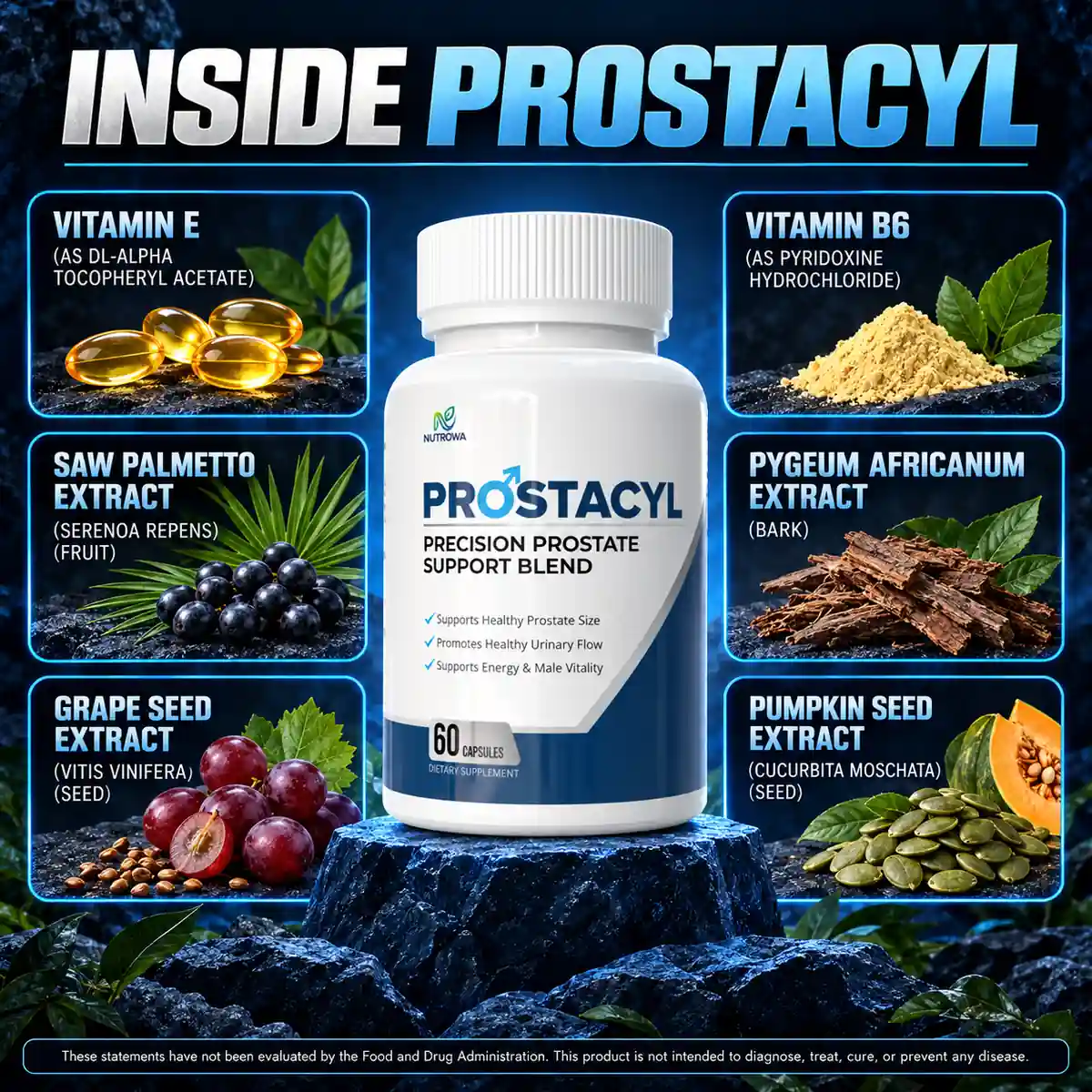
Two counts circulate for this formula and only one comes off the bottle. The seller’s listing graphic features Vitamin E, Vitamin B6, Saw Palmetto Extract, Pygeum africanum Extract, Grape Seed Extract and Pumpkin Seed Extract. The Supplement Facts panel carries three rows beyond those: Nettle Extract (leaf), Boron and Lycopene 5%.
A panel is a regulated declaration and a listing image is artwork, so nine is the figure this site works from. Read the bottle that arrives against the table above rather than against any picture; where the two disagree, the batch page sets out what to do next.
What are the nine ingredients in Prostacyl?
Nine actives, each with its label amount and its trial amount side by side.
Each card carries the printed amount and, beside it, the amount the research used. Those two figures are the story of this formula.
Saw Palmetto Extract
Serenoa repens, fruit300 mg · trials used 320 mgBerries from a low-growing American palm, and the most-swallowed botanical in the category. Three hundred milligrams sits a whisker under the 320 mg trial protocols fixed on decades ago, so quantity is not where this row falls down. The outcome is. Cochrane’s 2023 update gathered 4,656 men across 27 studies and reported, at high certainty, little to no benefit for urinary symptoms from saw palmetto alone.
Pygeum africanum Extract
bark, standardised to 3% phytosterols200 mg · trials used 100 mgBark from the African cherry, and the one row where this bottle is more generous than the literature it borrows from. Eighteen randomised trials in 1,562 men pooled to roughly double the odds of reporting improvement, nocturia down about a fifth and peak flow up about a quarter. The dosing study could not separate 50 mg twice daily from 100 mg once daily, pinning the researched amount at 100 mg. Two hundred is twice it.
Grape Seed Extract
Vitis vinifera, seed100 mg · no human prostate trialA proanthocyanidin-rich seed extract with a solid reputation in cardiovascular work and almost nothing behind it here. The only prostate-specific experiment is a 2024 rodent study at amounts that do not scale to a capsule; the one human signal is a cohort observation whose authors warned against promoting it, both on how it works.
Pumpkin Seed Extract
Cucurbita moschata, seed100 mg · 10 g/day of whole seed is what workedDelta-7 sterols and cucurbitin, supplied as an extract rather than as food. A one-year trial in 1,431 men ran three arms. Ten grams a day of whole pumpkin seed beat placebo, 58.5 per cent against 47.3 per cent, and the authors called even that provisional. The 1,000 mg extract arm finished level with placebo. This capsule carries the extract, at a tenth of that amount.
Nettle Extract
leaf50 mg · every BPH trial used rootUrtica dioica, and the row where the part of the plant decides everything. The lignans that bind sex hormone binding globulin were pulled out of nettle roots in 1997, and the urinary trial record has stayed underground ever since: the review that collects it is titled for the radix. Leaf is a separate preparation with separate traditional uses, none of them urinary.
Boron
as boron amino acid chelate10 mg · 20 mg is the adult upper intakeA trace element with no established human requirement, supplied by ordinary food at one to three milligrams a day. The Institute of Medicine set the adult tolerable upper intake at 20 mg, so this row spends half a day’s allowance before anything else in a cupboard is counted. Who it’s for says why that matters.
Lycopene 5%
Lycopersicum esculentum, tomato10 mg · about 0.5 mg of lycopeneThe pigment that reddens a ripe tomato, and the row whose percentage changes what its milligrams mean. Convention reads it as 10 mg of a preparation that is 5 per cent lycopene, landing near half a milligram of the carotenoid. The one randomised trial in men with an enlarged prostate gave 40 participants 15 mg a day, thirty times as much.
Vitamin E
as dl-alpha tocopheryl acetate25 mg (167% DV) · trials used 400 IUA fat-soluble antioxidant in the synthetic acetate form, at a quantity a good multivitamin would recognise. Its prostate history is the uncomfortable part of this panel: the largest trial on the question gave 35,533 men 400 IU a day of the same compound and counted more prostate cancers, not fewer. Twenty-five milligrams is far below that, as benefits works through.
Vitamin B6
as pyridoxine hydrochloride13.8 mg (812% DV) · a seventh of the 100 mg limitPyridoxine is a coenzyme in amino-acid handling and in the reactions that release energy from food, which is the honest basis for the third line on the bottle. It is an adequacy story: a man whose diet already supplies enough gains nothing from more. The 812 per cent is a large percentage on a small number.
Which plant parts and forms does Prostacyl use?
Six botanicals, and whether each arrives as the part its literature was built on.
| Botanical | Part on this label | Part used in the urinary research |
|---|---|---|
| Saw palmetto | Fruit | Fruit. The trials standardised on a fruit extract |
| Pygeum africanum | Bark | Bark. The pooled trials all used bark extract |
| Pumpkin seed | Seed, as an extract | Seed. The arm that beat placebo used 10 g of whole seed, not extract |
| Nettle | Leaf | Root. The whole urinary literature sits under the root |
| Grape seed | Seed | No urinary research to compare it against |
| Tomato | Fruit, as lycopene | Fruit. The single trial used purified lycopene |
Two preparations from one species can share a name and share almost nothing else, so plant part is a chemistry question rather than a botanical footnote. Five of the six rows match; nettle is the one that does not.
What do the Prostacyl standardisation figures mean?
Two percentages, a chelate, and the rows carrying neither.
“Standardised to 3% phytosterols” on the pygeum
A promise about concentration: three parts in every hundred of that 200 mg are the sterol fraction, roughly 6 mg. Trial-literature pygeum is standardised the same way, so this row is directly comparable rather than merely similarly named.
“Lycopene 5%” on the tomato row
The same convention applied to a carotenoid, and the reason the arithmetic matters. Five per cent of 10 mg is half a milligram. A reader who takes the 10 mg at face value is out by a factor of twenty, and the percentage is printed precisely so that they need not be.
“Boron amino acid chelate”, and the rows with no percentage
Chelate names a delivery form rather than a strength; the 10 mg is the boron itself, the unit the upper intake level uses. Four botanical rows carry a weight and a plant part but no standardisation marker, leaving the extract ratio to the maker.
Where do the Prostacyl amounts and the trials part company?
Nine printed figures, sorted by how they sit against the research behind them.
Set those nine figures against the figures the research used and the verdict splits four ways.
| Where the amount sits | Rows | What follows from it |
|---|---|---|
| Above the researched amount | Pygeum 200 mg | The best decision on this label: twice the 100 mg the dosing study settled on, in the one ingredient with an encouraging pooled result. |
| Level with the researched amount | Saw palmetto 300 mg | Correctly dosed against a 320 mg convention; the trials at that dose found very little. |
| Below it, or a different preparation | Pumpkin seed 100 mg, nettle leaf 50 mg, lycopene 10 mg at 5 per cent | Research run on a different amount, a different plant part or a different form. |
| No researched amount to compare with | Grape seed 100 mg, boron 10 mg, vitamin E 25 mg, vitamin B6 13.8 mg | Here for antioxidant, mineral or nutrient reasons rather than for a trial that set a dose. |
Every figure in the middle column is printed on the bottle, which is what makes the comparison possible.
Boron at 10 mg is half the 20 mg adult tolerable upper intake, from a single product. Anyone stacking a second boron supplement should total the two.
What else is inside a Prostacyl capsule?
Two entries under the panel, one of which rules the product out for some buyers.
Two lines account for everything that is not an active: gelatin (capsule) and brown rice flour.
Gelatin, the shell
An animal-derived protein and the standard material for a two-piece capsule. It dissolves quickly, carries no taste and keeps a botanical powder dry. It also settles a question some buyers need answered first: these capsules are not suitable for a vegetarian or vegan diet. Who it’s for takes that further.
Brown rice flour, the filler
Bulk. Nine actives at their printed weights come to 758.8 mg, under what a capsule of this size holds, so something has to occupy the rest and keep the fill weight consistent. Rice flour is inert and gluten-free.
Prostacyl ingredient questions
How many ingredients are in Prostacyl?
Nine actives, each with its own printed amount, plus two inactive lines: gelatin (capsule) and brown rice flour. The listing graphic features six of the nine; the Supplement Facts panel is the list that governs.
Is there a proprietary blend?
No. Every active has its own row and its own milligram figure, which is why each amount here can be checked against a trial.
Which ingredient is present in the largest amount?
Saw palmetto at 300 mg per two-capsule serving, then pygeum africanum bark extract at 200 mg. Those two carry roughly two-thirds of the active weight.
Is the nettle root or leaf?
Leaf, at 50 mg. The urinary research and the sex-hormone-binding-globulin chemistry both sit under nettle root, a different part of the same plant.
How much actual lycopene does a serving contain?
The row reads “Lycopene 5% … 10 mg”, so on the standard reading that is 10 mg of a preparation carrying 5 per cent lycopene, roughly 0.5 mg of the carotenoid. The one trial in men with an enlarged prostate used 15 mg a day.
Is Prostacyl vegetarian?
No. The capsule shell is gelatin, which is animal-derived, whatever else appears on the packaging. Neither inactive line is a gluten, dairy or soy source, and what the pack’s badges establish is audited on testing and quality.
Sources for the Prostacyl ingredient list
Every study named above, in the order the panel lists the ingredient it belongs to.
- Franco JV, Trivisonno L, Sgarbossa NJ, et al. Serenoa repens for the treatment of lower urinary tract symptoms due to benign prostatic enlargement. Cochrane Database Syst Rev. 2023;6(6):CD001423. PMID 37345871. https://pubmed.ncbi.nlm.nih.gov/37345871/
- Ishani A, MacDonald R, Nelson D, et al. Pygeum africanum for the treatment of patients with benign prostatic hyperplasia: a systematic review and quantitative meta-analysis. Am J Med. 2000;109(8):654-64. PMID 11099686. https://pubmed.ncbi.nlm.nih.gov/11099686/
- Chatelain C, Autet W, Brackman F. Comparison of once and twice daily dosage forms of Pygeum africanum extract in patients with benign prostatic hyperplasia: a randomized, double-blind study, with long-term open label extension. Urology. 1999;54(3):473-8. PMID 10475357. https://pubmed.ncbi.nlm.nih.gov/10475357/
- Vahlensieck W, Theurer C, Pfitzer E, et al. Effects of pumpkin seed in men with lower urinary tract symptoms due to benign prostatic hyperplasia in the one-year, randomized, placebo-controlled GRANU study. Urol Int. 2015;94(3):286-95. PMID 25196580. https://pubmed.ncbi.nlm.nih.gov/25196580/
- Schottner M, Gansser D, Spiteller G. Lignans from the roots of Urtica dioica and their metabolites bind to human sex hormone binding globulin (SHBG). Planta Med. 1997;63(6):529-32. PMID 9434605. https://pubmed.ncbi.nlm.nih.gov/9434605/
- Chrubasik JE, Roufogalis BD, Wagner H, et al. A comprehensive review on the stinging nettle effect and efficacy profiles. Part II: urticae radix. Phytomedicine. 2007;14(7-8):568-79. PMID 17509841. https://pubmed.ncbi.nlm.nih.gov/17509841/
- Institute of Medicine (US) Panel on Micronutrients. Arsenic, Boron, Nickel, Silicon, and Vanadium. In: Dietary Reference Intakes for Vitamin A, Vitamin K, Arsenic, Boron, Chromium, Copper, Iodine, Iron, Manganese, Molybdenum, Nickel, Silicon, Vanadium, and Zinc. Washington (DC): National Academies Press; 2001. NCBI Bookshelf NBK222322. https://www.ncbi.nlm.nih.gov/books/NBK222322/
- Schwarz S, Obermuller-Jevic UC, Hellmis E, et al. Lycopene inhibits disease progression in patients with benign prostate hyperplasia. J Nutr. 2008;138(1):49-53. PMID 18156403. https://pubmed.ncbi.nlm.nih.gov/18156403/
Order Prostacyl with all nine amounts in front of you
Nine actives, nine printed figures, 60 capsules a bottle and 60 days from purchase to change your mind.
One bottle $69 · six bottles $294 · 60-day money-back guarantee
Order Prostacyl On The Official WebsiteTwo capsules a day · 60 per bottle · lot PRO-26/GE-3008