Prostacyl Official Website › Supplement Facts
Supplement FactsProstacyl Supplement Facts: The Full Label Panel
By the Prostacyl Team at Getprostacyl · Medical review: Dr. Jason Hafron, MD · Revised
The Prostacyl panel lists nine rows, each with its own amount per two-capsule serving.
The serving holds vitamin E 25 mg, vitamin B6 13.8 mg, saw palmetto 300 mg, pygeum 200 mg, grape seed 100 mg, pumpkin seed 100 mg, nettle leaf 50 mg, boron 10 mg and lycopene 5% at 10 mg. One bottle has 60 capsules, or 30 servings.
For what each ingredient does, see the ingredients page.
Every row as the bottle prints it, and the arithmetic that turns a panel into a month of capsules.
What is on the Prostacyl Supplement Facts panel?
All nine rows, transcribed from the label artwork so the page can be held against the bottle.
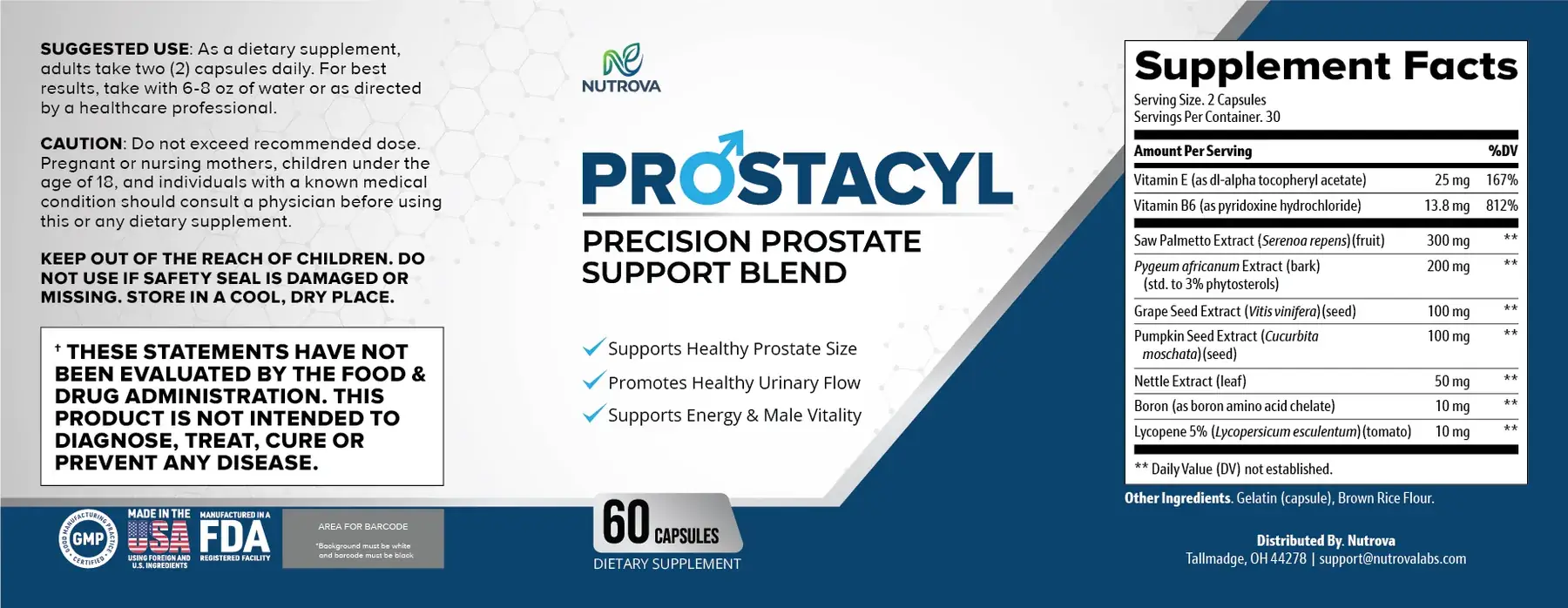
| Row | Amount per serving | % Daily Value |
|---|---|---|
| Vitamin E (as dl-alpha tocopheryl acetate) | 25 mg | 167% |
| Vitamin B6 (as pyridoxine hydrochloride) | 13.8 mg | 812% |
| Saw Palmetto Extract (Serenoa repens) (fruit) | 300 mg | † |
| Pygeum africanum Extract (bark), std. to 3% phytosterols | 200 mg | † |
| Grape Seed Extract (Vitis vinifera) (seed) | 100 mg | † |
| Pumpkin Seed Extract (Cucurbita moschata) (seed) | 100 mg | † |
| Nettle Extract (leaf) | 50 mg | † |
| Boron (as boron amino acid chelate) | 10 mg | † |
| Lycopene 5% (Lycopersicum esculentum) (tomato) | 10 mg | † |
Serving size two capsules. Servings per container thirty. A dagger in the right-hand column means no Daily Value exists for that substance.
Other ingredients: gelatin (capsule), brown rice flour.
Nine rows, nine numbers. Two of those rows are vitamins with an official Daily Value beside them; the remaining seven are botanicals and a mineral, and each carries a dagger instead.
What is absent from that block is a single grouped total. No line on this panel reads “proprietary blend” followed by one figure covering several plants at once, which is the arrangement that makes most labels in this category impossible to audit. Here a reader can take any one row and go looking for the trial that used that amount.
That is the whole argument for publishing the panel on a page of its own rather than summarising it. The bottle is specific, so the website can afford to be, and the ingredients page takes each row in turn and sets it beside the research it borrows its reputation from.
How the Prostacyl serving size turns into a month
Six figures, all of them derived from the two lines at the top of the panel.
| What the label states | Figure | Where it leads |
|---|---|---|
| Serving size | 2 capsules | The whole panel describes two capsules together, not one. |
| Servings per container | 30 | Thirty days of the printed dose from a full bottle. |
| Capsules per bottle | 60 | Two a day, so a bottle empties on day thirty. |
| Directions | Two capsules daily with 6–8 oz of water | Taken as one dose, with enough fluid to swallow both comfortably. |
| Three-bottle pack | 90 days | Three months at the label dose, without splitting a serving. |
| Six-bottle pack | 180 days | Six months, which outruns the refund window by four. |
Arithmetic from the serving size and the container count, both printed on the panel above.
The figure worth internalising is that one bottle is one month. Every price on the pricing page and every span on the timeline page is built on that single conversion, and it holds only if both capsules are taken on the same day.
Halving the dose to stretch a bottle across two months does not produce a gentler version of the panel. It produces a panel with every amount halved, which is a different product from the one the label describes and one nobody has studied.
The label wording is exact and worth quoting in full: “As a dietary supplement, adults take two (2) capsules daily. For best results, take with 6-8 oz of water or as directed by a healthcare professional.” That last clause is the label handing the decision to a clinician for anyone who has one involved.
What the Prostacyl other-ingredients line lists
Two entries, one of which decides whether the product is suitable at all.
Beneath the nine active rows the label prints two inactive ingredients: gelatin (capsule) and brown rice flour. Two entries is a short list by the standards of a capsule, and both are ordinary.
Gelatin is the shell itself. It is animal-derived, which settles a question some buyers need settled before anything else on the panel matters: these capsules are outside a vegetarian or vegan diet. That is a straightforward fact about the container rather than a criticism of the contents, and the testing and quality page is where the seal wall gets audited against it.
Brown rice flour is the flow agent and bulking filler that lets a capsule machine fill sixty shells to the same weight. It contributes nothing to the three claims on the front of the bottle and is not asked to.
What is not on this line is as informative as what is. There is no titanium dioxide, no magnesium stearate, no artificial colour and no sweetener, because a capsule has nothing to make palatable. Anyone comparing this with a gummy is comparing two ingredient lists of very different lengths.
Why the Prostacyl artwork shows six and the panel shows nine
One discrepancy between two of the seller's own documents, stated plainly and settled once.
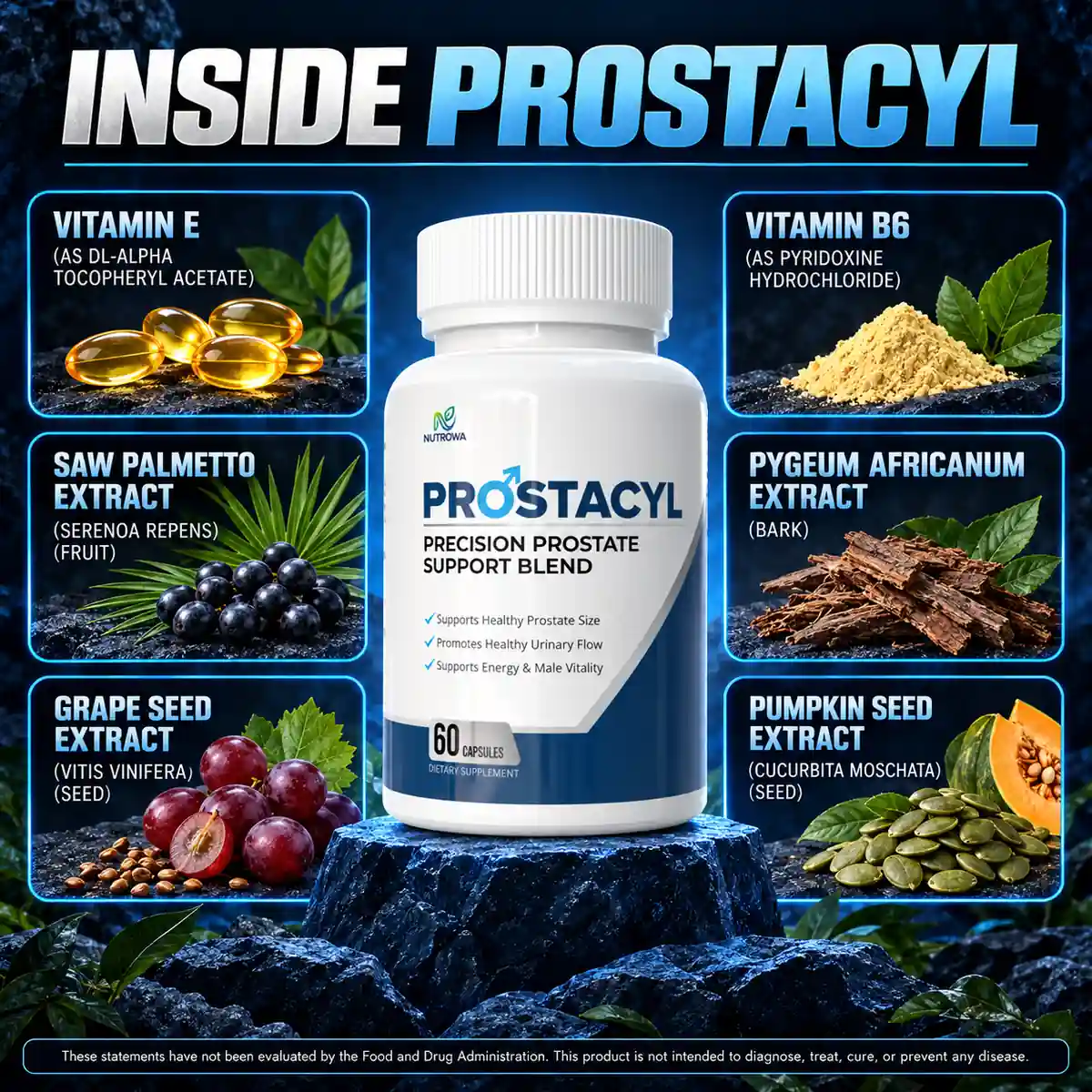
The seller's “Inside Prostacyl” graphic features Vitamin E, Vitamin B6, Saw Palmetto Extract, Pygeum africanum Extract, Grape Seed Extract, Pumpkin Seed Extract. Six ingredients, illustrated and captioned.
The Supplement Facts panel on the bottle prints nine. Nettle Extract (leaf), Boron, Lycopene 5% each have a row and an amount on the label and no place in that graphic at all.
Between a marketing illustration and a Supplement Facts panel, the panel is the document with legal weight and the one the bottle in your hand carries. It wins. The three extra rows are real, they are printed, and this site counts nine actives everywhere for that reason.
That is the whole of the discrepancy, and it is recorded here once. It does not reappear on every page, because a graphic that shows a subset of the panel is a shortened illustration rather than a contradiction of the formula.
If you chose this product from the six-ingredient graphic, you are also taking 50 mg of nettle leaf, 10 mg of boron and a 10 mg lycopene row. The boron figure in particular is worth knowing about before you start, and the side effects page explains why.
What the two %DV figures on the Prostacyl panel mean
Two percentages on a nine-row panel, and what each one is measuring against.
Only two rows carry a percentage, and both are vitamins with an established Daily Value. Vitamin E reads 25 mg at 167%. Vitamin B6 reads 13.8 mg at 812%.
Vitamin E at 167% of the Daily Value
The Daily Value for vitamin E is 15 mg of alpha-tocopherol, so 25 mg is roughly two-thirds again as much. The form here is dl-alpha tocopheryl acetate, the synthetic ester, which is the same compound used in the largest prostate trial ever run on vitamin E at sixteen times this amount.
Vitamin B6 at 812% of the Daily Value
A large-looking percentage against a small Daily Value of 1.7 mg. The figure that gives it context is the ceiling rather than the target: the Institute of Medicine put the adult upper intake at 100 mg a day, and 13.8 mg is about a seventh of it.
Why a percentage is not a ranking
A high percentage means the Daily Value is small, not that the ingredient is doing the most work. Saw palmetto at 300 mg is twelve times the mass of the vitamin E row and carries no percentage at all, because no Daily Value exists for it.
What a Daily Value is for
It is a labelling reference for a general adult diet, set so shoppers can compare one food or supplement with another. It is not a dose recommendation for any condition, and no percentage on this panel implies one.
Which Prostacyl rows carry a dagger, and why
Seven rows, one footnote, and one of the seven that deserves a second look.
Seven of the nine rows end in a dagger rather than a percentage: Saw Palmetto Extract, Pygeum africanum Extract, Grape Seed Extract, Pumpkin Seed Extract, Nettle Extract, Boron and Lycopene 5%.
The footnote underneath explains it in the standard wording: no Daily Value has been established. For the six botanicals that is because no regulator has set a reference intake for a plant extract, and none is likely to. Boron is the interesting case, because a dagger there means something slightly different.
Boron has no established human requirement, so there is nothing for a Daily Value to be a percentage of. It does have a ceiling. The Institute of Medicine's micronutrient panel put the adult ceiling at 20 mg a day, derived from reproductive and developmental toxicity, which makes the 10 mg on this label half of that allowance from one product before anything else in a cupboard is counted.
So the dagger is a labelling convention rather than a verdict. It says a reference intake does not exist for that substance. It says nothing at all about whether the amount beside it is a sensible one, which is a separate question that the ingredients page takes row by row.
How to read the two strength lines on the Prostacyl panel
Two rows on this panel carry a percentage inside the ingredient name, and they mean opposite things.
Lycopene 5%, 10 mg
A percentage inside an ingredient name describes the strength of the preparation, not the amount in the capsule. On the standard reading, 10 mg of a 5 per cent lycopene preparation supplies around 0.5 mg of lycopene itself, with the balance made up of the tomato carrier it was extracted into. The single randomised trial in benign prostatic hyperplasia used 15 mg a day.
Pygeum africanum, standardised to 3% phytosterols
The same grammar, used well. Standardisation names the constituent the extract is guaranteed against, which is how a buyer knows one batch resembles the last. At 200 mg the row is generous: the dosing trial compared 50 mg twice daily with 100 mg once daily and found them alike, so this label sits above both.
Where a strength line is absent
Saw palmetto, grape seed, pumpkin seed and nettle are printed as plain extract weights with no standardisation named. That is common practice and it is what most of the category does, but it means the row states a mass rather than a guaranteed constituent.
How to use both numbers together
Read the milligrams first, then look for a percentage. If one is there, multiply. That single habit is enough to tell a 10 mg row that means 10 mg from a 10 mg row that means half of one.
How to check a Prostacyl bottle against this panel
Six checks, in the order that catches a mismatch soonest.
Start with the serving size, not the ingredient list
Two capsules, thirty servings. If the bottle in your hand states a different serving size, every amount below it is describing a different quantity of powder and the comparison has to be redone.
Read the nine rows in order
The panel runs vitamins first, then botanicals by descending weight, then boron and lycopene. A row in a different position, or a tenth row, means a reformulation rather than a misprint.
Check the nettle row says leaf
It is the row most often misdescribed by third parties, who write “nettle root” because that is what the research used. The label says leaf. If your bottle says root, it is not the product this page describes.
Check the other-ingredients line
Gelatin and brown rice flour. A vegetarian capsule shell would be a different formulation, and it would also resolve a conflict this site has recorded rather than smoothed over.
Match the lot against your paperwork
Bottles shipped from this desk carry lot PRO-26/GE-3008 with certificate reference PRO-3008-26-GE. Those are filing references rather than laboratory results, and the batch page is direct about the difference.
Photograph the panel before the first capsule
Thirty seconds now saves an argument later. A dated photograph of the panel, the lot and the expiry is the only record a buyer controls, and it is the thing a refund conversation runs smoothest with.
What the Prostacyl panel can and cannot settle
A Supplement Facts block is a strong document about content and a silent one about outcome.
What this panel establishes
- What is in a serving, by name and by weight, for all nine actives.
- How many servings a bottle holds, and therefore how long a pack lasts.
- Which plant part each botanical came from, which is how the nettle row gives itself away.
- The strength of the two standardised preparations, lycopene and pygeum.
- What the shell is made of, and what else is in the capsule besides the actives.
- Enough detail to set every row against a published trial, which is unusual in this category.
What no panel can establish
- Whether any of those amounts does anything. A panel is a statement of content, never of effect.
- Whether the extract ratio behind a plain milligram figure matches the one a trial used.
- How much of a botanical survives digestion, which no label anywhere prints.
- Whether the amount chosen resembles the amount studied. Four of these nine do not, and the ingredients page names them.
- Anything about an individual. Fluid intake, caffeine, alcohol and sleep move the same symptoms this formula is sold for.
Sources cited on this Prostacyl page
- Klein EA, Thompson IM Jr, Tangen CM, et al. Vitamin E and the risk of prostate cancer: the Selenium and Vitamin E Cancer Prevention Trial (SELECT). JAMA. 2011;306(14):1549-56. PMID 21990298. https://pubmed.ncbi.nlm.nih.gov/21990298/
- Institute of Medicine (US) Standing Committee on the Scientific Evaluation of Dietary Reference Intakes. Vitamin B6. In: Dietary Reference Intakes for Thiamin, Riboflavin, Niacin, Vitamin B6, Folate, Vitamin B12, Pantothenic Acid, Biotin, and Choline. Washington (DC): National Academies Press; 1998. NCBI Bookshelf NBK114313. https://www.ncbi.nlm.nih.gov/books/NBK114313/
- Institute of Medicine (US) Panel on Micronutrients. Arsenic, Boron, Nickel, Silicon, and Vanadium. In: Dietary Reference Intakes for Vitamin A, Vitamin K, Arsenic, Boron, Chromium, Copper, Iodine, Iron, Manganese, Molybdenum, Nickel, Silicon, Vanadium, and Zinc. Washington (DC): National Academies Press; 2001. NCBI Bookshelf NBK222322. https://www.ncbi.nlm.nih.gov/books/NBK222322/
- Chatelain C, Autet W, Brackman F. Comparison of once and twice daily dosage forms of Pygeum africanum extract in patients with benign prostatic hyperplasia: a randomized, double-blind study, with long-term open label extension. Urology. 1999;54(3):473-8. PMID 10475357. https://pubmed.ncbi.nlm.nih.gov/10475357/
- Schwarz S, Obermuller-Jevic UC, Hellmis E, et al. Lycopene inhibits disease progression in patients with benign prostate hyperplasia. J Nutr. 2008;138(1):49-53. PMID 18156403. https://pubmed.ncbi.nlm.nih.gov/18156403/
Order Prostacyl with the panel in front of you
Nine actives, every amount printed, 60 capsules to a bottle and 60 days from purchase to change your mind. The three-bottle pack ships free.
One bottle $69 · six bottles $294 · 60-day money-back guarantee
Order Prostacyl On The Official WebsiteTwo capsules a day · 60 per bottle · lot PRO-26/GE-3008