Prostacyl Official Website › Choosing a supplement
Choosing a supplementChoosing A Prostate Supplement: Seven Checks
By the Prostacyl Team at Getprostacyl · Medical review: Dr. Jason Hafron, MD · Revised
Seven questions answerable from a label and a website in about five minutes: are the amounts printed, is the plant part named, does the form match the trials, does each amount sit in the researched range, do the seals agree with the ingredients, is there a refund route with a telephone number, and does the label stay inside what a supplement may claim.
A checklist you can carry to any bottle, applied at the end to the one sold here.
Why a checklist beats a brand comparison
What seven fixed questions can do that a ranked list of brands cannot.
Brand comparisons age badly and they are almost always written by somebody selling one of the brands. A checklist survives because the questions do not change when the products do, and because you can answer them yourself standing in an aisle.
Every check below is answerable from information a company has already published. None of them requires a laboratory, a subscription or a degree, and none of them asks you to judge whether an ingredient works — that question belongs to the companion guide and to the trials it cites.
What the seven measure is whether a label tells you enough to hold it to account. That is a lower bar than efficacy and a great deal of this category fails it.
The seven checks
Seven questions, each answerable from the label and the seller’s own pages.
1. Is an amount printed for every active?
A proprietary blend gives one total for several ingredients, which means no individual amount can be compared with any trial. The blend total is a ceiling and nothing more: the first ingredient could account for almost all of it. If the panel prints a number per row, every other check on this list becomes possible.
2. Is the species and the plant part named?
“Nettle extract” is not an ingredient; nettle root and nettle leaf are two ingredients with different chemistry and different evidence. The same goes for bark, fruit, seed and aerial parts. A label that names only the plant has left out the part that decides whether the research applies.
3. Does the form match the form that was studied?
An extract is not the food, and one extract is not another. Pumpkin seed is the cleanest case: in the largest trial the whole seed beat placebo and the extract did not. If a label uses a different form from the trials, the trials are not evidence for what is in the capsule.
4. Does each amount sit in the range its trials used?
This is arithmetic once check one passes. Saw palmetto research standardised on 320 mg a day, pygeum on 100 mg, lycopene trials on 15 mg. An amount far below the researched figure is a name on a panel rather than a dose, and a percentage row needs reading twice.
5. Do the seals agree with the ingredient list?
Badges are assembled for a brand and applied to a formula, which is how a vegetarian badge ends up on a gelatin capsule. Read the other-ingredients line against the badge wall. A seal that contradicts the label tells you something about the company’s checking, not just about the capsule.
6. Is there a refund route with a telephone number and an address?
A stated window, a telephone number that is answered, a return address and a written procedure. If the only route is a contact form, the practical value of the guarantee is whatever the company decides later, and the refund is the only protection a buyer has in an unregulated category.
7. Does the label stay inside what a supplement may claim?
Structure and function claims only: supports, promotes, helps maintain. A product promising to shrink a prostate, treat an enlarged one or prevent cancer has broken the rule that governs the whole category, and a company casual about that rule is not a safe bet on sourcing either.
Scoring Prostacyl against all seven
The same seven questions, answered about the product this website sells.
| Check | Verdict | The evidence for the verdict |
|---|---|---|
| 1. An amount for every active | Pass | All 9 rows carry their own figure and there is no proprietary blend. This is the best thing about the label. |
| 2. Species and plant part named | Pass | Fruit for saw palmetto, bark for pygeum, seed for grape and pumpkin, leaf for nettle, tomato for lycopene. The parts are printed, including the awkward one. |
| 3. Form matches the studied form | Fail | The nettle is leaf where every BPH trial used root, and the pumpkin seed is the extract form rather than the whole seed that beat placebo. |
| 4. Amounts in the researched range | Partial | Saw palmetto 300 mg against 320 mg and pygeum 200 mg against 100 mg both qualify. Pumpkin seed, nettle and lycopene sit well below anything studied. |
| 5. Seals agree with the ingredients | Fail | A vegetarian badge ships on a pack whose other-ingredients line reads “Gelatin (capsule)”. Both cannot be true. |
| 6. A real refund route | Pass | 60 days from purchase on every pack, opened bottles included, with a refund phone line, a written five-step procedure and a return address at 90 Park Avenue, Floor 15, New York, NY 10016, USA. |
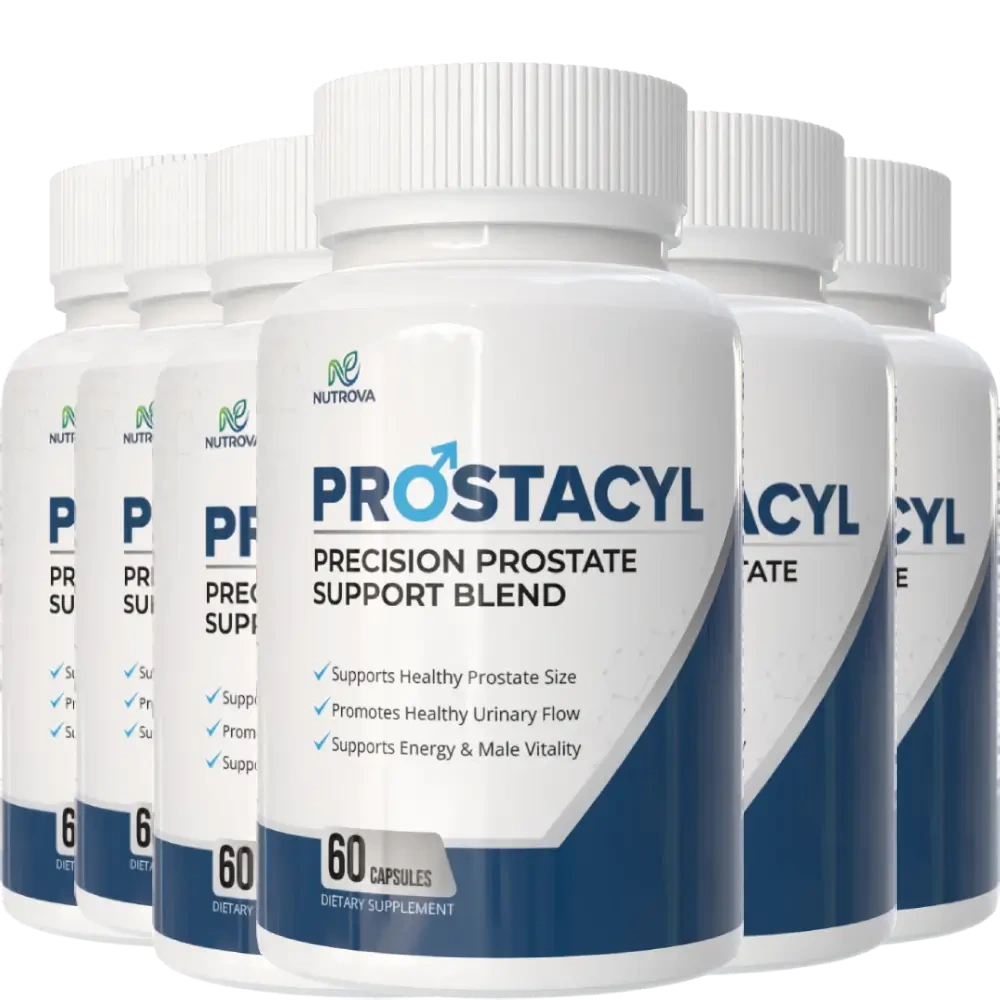
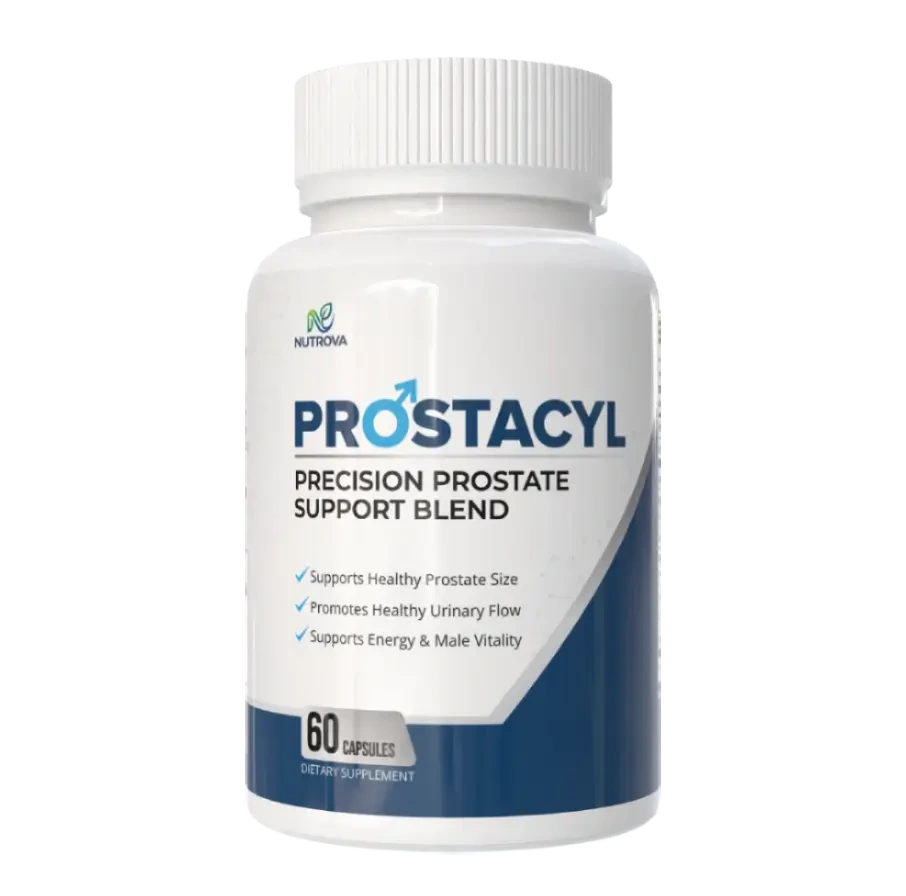
| 7. Claims inside the rules | Pass | Three structure and function lines on the bottle: supports healthy prostate size; promotes healthy urinary flow; supports energy and male vitality. |
Four passes, one partial, two outright failures. The failures are the reason the passes are worth reading.
Where Prostacyl falls short of its research doses
What exactly is wrong, why it cannot be argued away, and how it was found.
Check three fails on two ingredients. The nettle on this panel is leaf at 50 mg, and the prostate literature for this plant is a literature about the root, with the lignans behind the proposed mechanism isolated from roots. The pumpkin seed is an extract at 100 mg, and in the one-year GRANU trial it was the whole seed at 10 g a day that beat placebo while the 1,000 mg extract arm did not.
Neither of those is a matter of opinion and neither can be argued away by a retailer. They are printed on the label, which is precisely why they can be checked: a proprietary blend would have hidden both.
Check five fails on the badge wall. A vegetarian badge ships with a pack whose capsule shell is gelatin. The label is the document that governs, so the product is not suitable for a vegetarian or vegan diet, and the quality page reads every badge on the pack one at a time rather than reproducing them as a trust strip.
Check four lands in between. Two of the six botanicals are dosed at or above the amounts their trials used, and three are well under. That is a mixed result rather than a failure, and calling it a pass would be generous in a way this page is trying not to be.
The rows it passes, and what they are worth
Four passes, ranked by how much they actually protect a buyer.
Check one is the one that matters most, because it is the gateway to the rest. This label prints an amount for every one of its 9 actives, which is why this page could score checks two, three and four at all. A great many competitors cannot be scored past the first question.
Check two follows from it. The parts are named, including “leaf” against the nettle, which is the disclosure that produced the failure two rows down. A company printing the inconvenient word is telling you something useful about how it handles the rest.
Check four is half-earned and the half worth naming is pygeum. At 200 mg it is double the 100 mg a day the dosing trial found effective, in the one ingredient on the panel with a genuinely encouraging pooled result. Saw palmetto at 300 mg is within touching distance of the 320 mg the trials used, although the 2023 Cochrane review found that amount does little or nothing.
Check six is the practical one. A 60-day window with a telephone number, a written procedure and a return address is worth more in this category than any badge, because it is the only thing on the list a buyer can enforce.
Applying the same seven to anything else
What usually breaks first, and the order to ask the questions in.
Take the list to the next label you look at. In practice most products fail at check one, because a proprietary blend is still the industry default, and a failure there makes checks three and four unanswerable rather than merely unfavourable.
The second commonest failure is check two. A panel reading “nettle extract” or “pumpkin extract” with no part and no standardisation is asking you to assume the research applies. The third is check six: a guarantee with no telephone number behind it and no return address published anywhere.
A useful way to keep score is to write the seven down and answer them before reading any marketing copy at all. The panel, the other-ingredients line, the badge wall and the returns page answer all seven between them, and none of those four is written by the copywriter.
If a product passes all seven, you have established that the company is telling you what is in the bottle and will take it back. That is worth having, and it is still not the same as evidence that it works.
What this checklist cannot tell you
Five questions the seven checks were never built to answer.
- Whether the formula works. A label can pass all seven checks and still be a capsule with no trial behind the finished product, which describes almost everything in this category.
- Whether the amount in the capsule is the amount on the panel. That is a laboratory question, and a printed figure is a declaration made at manufacture.
- Whether an ingredient suits you personally. Interactions and existing conditions are a conversation with whoever prescribes for you.
- Whether the price is fair. Cost per day is a separate calculation and a cheap capsule of the wrong plant part is not a bargain.
- Whether your symptoms need something else entirely. That is the one question worth answering before any of the other six.
The checklist is a disclosure test rather than an efficacy test, and keeping the two apart is the whole discipline. MedlinePlus covers what an enlarged prostate is, the American Urological Association guideline covers what an initial assessment involves, and the companion guide covers what the evidence supports ingredient by ingredient.
Sources cited on this Prostacyl page
- Chrubasik JE, Roufogalis BD, Wagner H, et al. A comprehensive review on the stinging nettle effect and efficacy profiles. Part II: urticae radix. Phytomedicine. 2007;14(7-8):568-79. PMID 17509841. https://pubmed.ncbi.nlm.nih.gov/17509841/
- Schottner M, Gansser D, Spiteller G. Lignans from the roots of Urtica dioica and their metabolites bind to human sex hormone binding globulin (SHBG). Planta Med. 1997;63(6):529-32. PMID 9434605. https://pubmed.ncbi.nlm.nih.gov/9434605/
- Vahlensieck W, Theurer C, Pfitzer E, et al. Effects of pumpkin seed in men with lower urinary tract symptoms due to benign prostatic hyperplasia in the one-year, randomized, placebo-controlled GRANU study. Urol Int. 2015;94(3):286-95. PMID 25196580. https://pubmed.ncbi.nlm.nih.gov/25196580/
- Chatelain C, Autet W, Brackman F. Comparison of once and twice daily dosage forms of Pygeum africanum extract in patients with benign prostatic hyperplasia: a randomized, double-blind study, with long-term open label extension. Urology. 1999;54(3):473-8. PMID 10475357. https://pubmed.ncbi.nlm.nih.gov/10475357/
- Ishani A, MacDonald R, Nelson D, et al. Pygeum africanum for the treatment of patients with benign prostatic hyperplasia: a systematic review and quantitative meta-analysis. Am J Med. 2000;109(8):654-64. PMID 11099686. https://pubmed.ncbi.nlm.nih.gov/11099686/
- Franco JV, Trivisonno L, Sgarbossa NJ, et al. Serenoa repens for the treatment of lower urinary tract symptoms due to benign prostatic enlargement. Cochrane Database Syst Rev. 2023;6(6):CD001423. PMID 37345871. https://pubmed.ncbi.nlm.nih.gov/37345871/
- MedlinePlus. Enlarged Prostate (BPH). Bethesda (MD): U.S. National Library of Medicine, National Institutes of Health. https://medlineplus.gov/enlargedprostatebph.html
- Lerner LB, McVary KT, Barry MJ, et al. Management of Lower Urinary Tract Symptoms Attributed to Benign Prostatic Hyperplasia: AUA Guideline Part I - Initial Work-up and Medical Management. J Urol. 2021;206(4):806-817. PMID 34384237. https://pubmed.ncbi.nlm.nih.gov/34384237/
Order Prostacyl with the scorecard in front of you
Four passes, one partial and two failures, all of them checkable against the printed panel. Packs run $49 to $69 a bottle with 60 days from purchase to change your mind.
One bottle $69 · six bottles $294 · 60-day money-back guarantee
Order Prostacyl On The Official WebsiteTwo capsules a day · 60 per bottle · lot PRO-26/GE-3008