Prostacyl Official Website › Blog › Saw Palmetto
The Saw Palmetto Question: Right Dose, Wrong Result
Most arguments about supplement labels are arguments about arithmetic. This one is not. The amount on this panel is within touching distance of what the trials used, and the trials are the problem.
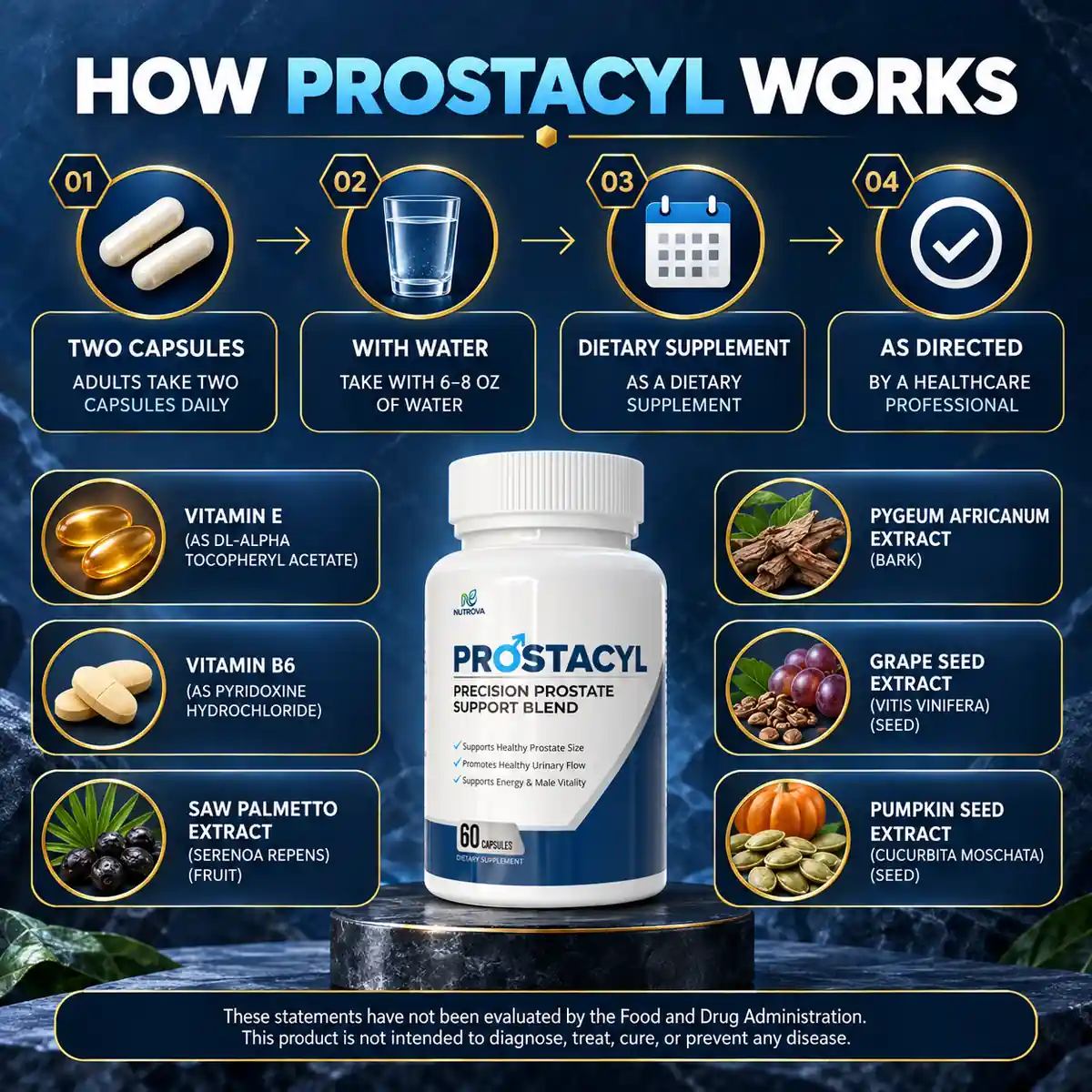
- The panel prints 300 mg of saw palmetto fruit extract per two-capsule serving. The trials standardised on 320 mg a day.
- Nobody can accuse this label of skimping on its lead ingredient. The dose is fair.
- Cochrane pooled 27 studies covering 4,656 men in 2023 and found little to no benefit, graded at high certainty.
- STEP ran a year and found nothing. CAMUS pushed the dose to 960 mg a day and placebo did marginally better.
- The claim that saw palmetto masks a PSA test is not supported. The pre-specified CAMUS analysis found no effect on serum PSA beyond placebo.
300 mg against 320 mg
Start with the number, because it is the part that reflects well on this bottle. Two capsules deliver 300 mg of Serenoa repens fruit extract. The clinical literature settled long ago on 320 mg a day, usually as 160 mg twice daily, and that is the figure almost every trial worth reading has used.
Twenty milligrams is a six per cent difference, and nobody is going to build a case on it. On the most-studied ingredient in this category, the panel has put up close to the researched amount and printed it where anyone can check.
Which makes saw palmetto the opposite of the nettle row, where the plant part itself is the objection. Here the dose is right. The difficulty is downstream of that.
What the 2023 review pooled, and how it graded it
The Cochrane review published in June 2023 is the largest synthesis anyone has done on this question. It gathered 27 studies covering 4,656 men and asked whether Serenoa repens, taken on its own, improves lower urinary tract symptoms compared with placebo.
The answer was that it probably does not, and the review said so at HIGH certainty, which is the strongest grade the system allows. High certainty means further research is very unlikely to change the estimate. It is a rare grade in botanical medicine and it is not handed out generously.
The pooled numbers are small enough to state in full. At three to six months the symptom score moved by 0.90 points in favour of saw palmetto. At twelve to seventeen months it moved by 0.07 points in favour of placebo. Neither figure is a result anyone would notice in a bathroom.
What a high-certainty null looks like
There is a difference between “we do not know” and “we looked hard and found nothing”, and this literature has moved from the first to the second. Early trials were short, small and often funded by the people selling the extract; the later ones were longer, larger and independently funded, and the effect shrank as the method improved.
What a point on the symptom score is worth
Pooled differences mean nothing without the scale they sit on, so here is the scale. The standard questionnaire asks seven questions about the last month and scores each from 0 to 5, giving a total between 0 and 35.
| On the symptom score | What it represents |
|---|---|
| 0 to 7 points | Mild symptoms |
| 8 to 19 points | Moderate symptoms |
| 20 to 35 points | Severe symptoms |
| About 3 points of change | Roughly the smallest shift a man tends to notice |
| 0.90 points | The three-to-six-month difference the 2023 review pooled |
| 0.07 points the other way | The twelve-to-seventeen-month difference, favouring placebo |
The seven-question score used across this literature runs 0 to 35. The last two rows are the pooled figures from the review, set against the scale they sit on.
Against that scale, 0.90 points is roughly a third of the smallest change a man would be likely to register, and it disappears entirely by the end of the first year. If one number here is worth carrying away, it is that one.
STEP: a year, properly blinded, nothing
The STEP trial was funded by the National Institutes of Health and published in the New England Journal of Medicine in 2006. It gave 225 men with moderate to severe symptoms either 160 mg of saw palmetto extract twice daily or a matched placebo, and followed them for a full year.
Nothing separated the two groups. Not the symptom score, not peak urinary flow rate, not prostate size, not residual volume, not quality of life. The trial was designed by people with no stake in the answer and it reported one.
The blinding is worth a word, because saw palmetto is not a neutral-tasting capsule. STEP matched its placebo for taste and smell, which earlier trials had not always managed, and a man who can tell which arm he is in is a man whose symptom diary is no longer blind.
CAMUS: three doses, and the wrong one won
If the objection to STEP is that the dose was too low, CAMUS was built to answer it. Published in JAMA in 2011, it randomised 369 men and escalated the dose in stages: 320 mg a day for 24 weeks, then 640 mg, then 960 mg, out to 72 weeks in total.
Three times the standard dose produced no dose-response and no separation from placebo. The placebo group’s symptom scores improved marginally more than the treatment group’s, which is the pattern you get from two arms of the same trial doing the same thing.
Three practical readings of that result:
- A larger dose is not a hidden fix. The dose ceiling has been tested and it did not help.
- Nobody should take more than the two capsules this label asks for on the theory that more would work harder.
- The placebo improvement in both STEP and CAMUS was real and substantial, which says something about how much urinary symptoms move on their own.
Four studies and two reviews, set beside one another:
| The study | What it compared | What it reported |
|---|---|---|
| Cochrane review, 2023, 27 studies in 4,656 men | Serenoa repens alone against placebo for urinary symptoms | Little to no benefit, graded at high certainty |
| STEP, 225 men, one year | 320 mg a day against placebo | No separation on symptom score, peak flow or quality of life |
| CAMUS, 369 men, 72 weeks | Escalating doses of 320, then 640, then 960 mg a day | Placebo improved marginally more, with no dose-response |
| Hexanic extract meta-analysis, 2018 | One branded hexanic preparation against placebo and against drugs | Improvements reported in nocturia and peak urinary flow |
| CAMUS PSA analysis, pre-specified | Serum PSA at every one of those three doses | No effect on PSA beyond placebo |
Trial sizes and durations as the published papers report them; each one is listed in full below.
The Prostacyl panel puts a number on every row
Saw palmetto 300 mg, pygeum 200 mg, and seven more actives with their amounts printed. Two capsules a day, 60 to a bottle, 60 days from purchase to decide.
One bottle $69 · six bottles $294 · 60-day money-back guarantee
Order Prostacyl On The Official WebsiteTwo capsules a day · 60 per bottle · lot PRO-26/GE-3008
The counter-argument, stated properly
One strand of this literature runs the other way, and a reader deciding what to buy deserves it.
A 2018 systematic review and meta-analysis looked specifically at a hexanic extract of Serenoa repens, a branded preparation made by a particular extraction method, rather than at saw palmetto products as a class. Pooling its trials, it reported reductions in nocturia and improvements in peak urinary flow against placebo.
Three things have to be said in the same breath:
- Extraction method genuinely does change what ends up in a capsule, so the argument is not absurd on its face.
- The review covers one commercial preparation rather than saw palmetto as a class, and several of its authors have declared ties to the company behind it.
- The Cochrane review weighed the wider evidence, including that preparation, and still landed where it landed.
This panel names the species, the plant part and the weight. It identifies no extraction method, so a buyer cannot place this capsule inside that narrower argument. The favourable reading exists, it applies to a specific product, and it cannot be claimed here.
The PSA myth, and what the evidence says instead
It became common knowledge somewhere along the way that saw palmetto interferes with a PSA reading and can hide a problem. The evidence does not support it.
The pre-specified PSA analysis inside CAMUS is the right place to settle this, because CAMUS escalated men all the way to 960 mg a day. Serum PSA in the saw palmetto arms did not differ from placebo at any of the three doses. NCCIH reaches the same conclusion on its public information page.
The comparison people are reaching for is finasteride, a prescription medicine that does lower PSA measurably and whose readings are interpreted with that in mind. Saw palmetto is not in that position.
Tell whoever orders the test what you take, the way you would mention anything else in the cupboard. What is not warranted is skipping a test, delaying one, or discounting a result on the strength of an interference the trials looked for and did not find.
Why it is still the lead row on this panel
The fair question is why a formula would carry 300 mg of something with that record. Three answers, and only one of them is flattering.
- Expectation. Saw palmetto is the name attached to this category in the public mind, and a prostate formula without it would be harder to sell whatever the reviews say.
- History and tolerability. It has been used for this purpose for over a century and carries a long record of ordinary tolerability, which is not nothing on a panel where other rows have thinner safety data behind them.
- It is not carrying the formula alone. Pygeum africanum sits at 200 mg, double the amount its own dosing trial found effective, and its pooled result across eighteen trials is the most encouraging thing on this label.
The mechanism page separates the three pathways stacked on this panel, and they do not all rest on the same ingredient.
How to weigh this if you are deciding
None of this says the bottle is dishonest. It is about what one row can be expected to contribute, and it points at a few specific moves.
- Do not buy this formula for the saw palmetto. If that is the ingredient you want, the best modern evidence says it will not do much, and a single-ingredient capsule costs a fraction of this.
- Weigh the pygeum row instead. It is the one place this label is more generous than the research, and the ingredients page sets out what its trials found.
- Count something before you start. Night-time trips are easy to count and the placebo improvements in STEP and CAMUS show how easily this symptom moves on its own.
- Know the window. The 60-day guarantee runs from the date of purchase, not from the first capsule, and the guarantee page lists the five steps that claim it.
- Have the symptoms looked at once. A capsule is a reasonable thing to take after that, and a poor substitute for it.
Prostacyl is sold as a dietary supplement for healthy adult men of 18 and over, and carries no FDA approval. Reporting what the saw palmetto trials measured is not a claim that this capsule does anything to benign prostatic hyperplasia, and no dietary supplement may make one.
References
- Franco JV, Trivisonno L, Sgarbossa NJ, et al. Serenoa repens for the treatment of lower urinary tract symptoms due to benign prostatic enlargement. Cochrane Database Syst Rev. 2023;6(6):CD001423. PMID 37345871. https://pubmed.ncbi.nlm.nih.gov/37345871/
- Bent S, Kane C, Shinohara K, et al. Saw palmetto for benign prostatic hyperplasia. N Engl J Med. 2006;354(6):557-66. PMID 16467543. https://pubmed.ncbi.nlm.nih.gov/16467543/
- Barry MJ, Meleth S, Lee JY, et al. Effect of increasing doses of saw palmetto extract on lower urinary tract symptoms: a randomized trial. JAMA. 2011;306(12):1344-51. PMID 21954478. https://pubmed.ncbi.nlm.nih.gov/21954478/
- Andriole GL, McCullum-Hill C, Sandhu GS, et al. The effect of increasing doses of saw palmetto fruit extract on serum prostate specific antigen: analysis of the CAMUS randomized trial. J Urol. 2013;189(2):486-92. PMID 23253958. https://pubmed.ncbi.nlm.nih.gov/23253958/
- Vela-Navarrete R, Alcaraz A, Rodriguez-Antolin A, et al. Efficacy and safety of a hexanic extract of Serenoa repens (Permixon) for the treatment of lower urinary tract symptoms associated with benign prostatic hyperplasia (LUTS/BPH): systematic review and meta-analysis. BJU Int. 2018;122(6):1049-1065. PMID 29694707. https://pubmed.ncbi.nlm.nih.gov/29694707/
- National Center for Complementary and Integrative Health. Saw Palmetto: Usefulness and Safety. https://www.nccih.nih.gov/health/saw-palmetto