Prostacyl Official Website › Blog › Nettle Root Or Leaf
Nettle Root Or Nettle Leaf? The Difference That Matters
Urtica dioica reaches prostate labels in two completely different forms, and most packaging never says which one is in the capsule. This panel does say, in brackets, and the answer is the one the research did not use.
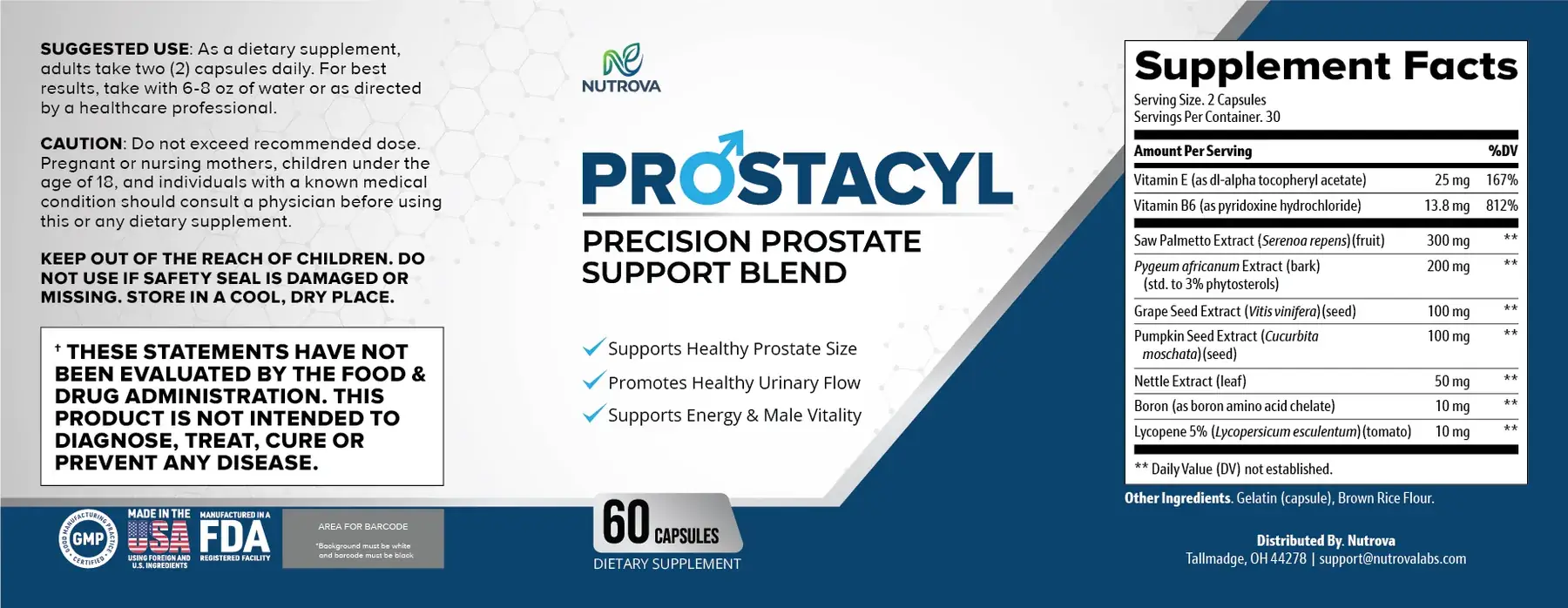
- The panel carries 50 mg of nettle LEAF per two-capsule serving, and prints both the part and the weight.
- The benign prostatic hyperplasia literature is built on nettle ROOT. That is where every controlled trial went.
- The compounds behind the proposed mechanism, a group of lignans that bind sex hormone binding globulin, were taken out of roots.
- Two 2007 reviews by the same authors handle the root and the aerial parts as separate subjects, because their evidence bases barely overlap.
- The root work ran at hundreds of milligrams a day, usually alongside saw palmetto, over months rather than weeks.
One plant, two different ingredients
Stinging nettle grows nearly everywhere in the temperate world and has been eaten, brewed and applied to skin for as long as anyone has written things down. What gets missed is that a nettle plant supplies two distinct raw materials, harvested at different times of year by different methods, and sold for different purposes.
Above ground are the stems and leaves, the part that stings. Below ground is a pale, creeping rhizome that spreads sideways through the soil and is lifted in autumn. European pharmacopoeias list them as two separate drugs with two separate monographs, which is the clearest signal that the distinction is not a botanist's fussiness.
What the aerial parts carry
Leaf material is rich in flavonoids, carotenoids, chlorophyll, minerals and organic acids. It is the part that ends up in soup, in tea, and in the products sold for joint comfort and for seasonal nasal symptoms. Its human research follows those uses.
What the root carries
Root material is a different chemical proposition: lignans, sterols including beta-sitosterol, a set of polysaccharides and a lectin unique to the plant. Those are the compounds that made anyone look at nettle in connection with the prostate in the first place, and they are concentrated below ground rather than above it.
Where the prostate mechanism came from
Sex hormone binding globulin is the transport protein that carries testosterone and oestradiol around the bloodstream and decides how much of each is free to act. The idea that nettle might touch prostate tissue at all rests on compounds that interfere with that protein.
Those compounds have a documented origin. The 1997 paper that identified them isolated lignans from the roots of Urtica dioica and showed that they, and several of their metabolites, bind to human sex hormone binding globulin. The title of that paper says “roots”, and the methods section says it twice.
That is a laboratory finding rather than a clinical outcome. Binding in a test tube tells you a mechanism is plausible; it does not tell you that a man swallowing a capsule will pass urine more comfortably.
The literature splits the plant in half
The tidiest demonstration of the divide is bibliographic. In 2007 the same three authors published two reviews in the same journal in the same year, and they did not combine them.
Part I covers herba urticae, the aerial parts. Part II covers urticae radix, the root, and it is the one where lower urinary tract symptoms appear. Splitting a single species into two review articles is a decision authors only take when the two halves cannot sensibly be pooled.
| Root (urticae radix) | Leaf and aerial parts (herba urticae) | |
|---|---|---|
| Compounds usually named | Lignans, sterols including beta-sitosterol, polysaccharides, a lectin | Flavonoids, carotenoids, chlorophyll, minerals, organic acids |
| Where the human trials sit | Lower urinary tract symptoms, most often paired with saw palmetto | Joint discomfort, seasonal complaints and topical preparations |
| The proposed prostate mechanism | Binding to sex hormone binding globulin, plus enzyme activity in glassware | A different subject with a different set of questions |
| Amounts used in that work | Hundreds of milligrams of extract a day, over months | Teas, infusions and extracts standardised for other purposes |
| What this bottle carries | — | 50 mg |
Drawn from the two 2007 reviews cited below, which cover the same plant in separate papers.
Read the last row on its own and the position is plain. The prostate column belongs to the root, and this bottle is stocked from the other column.
What the root studies actually ran
The best-known controlled work on nettle and urinary symptoms did not test nettle by itself. A placebo-controlled, double-blind, multicentre trial ran a fixed combination of saw palmetto fruit and nettle root for a year and reported on long-term efficacy and safety together.
That design has two consequences. The evidence attaches to root material, and a combination trial measures a combination, so nettle's own contribution inside it was never separated out.
Four things the root literature does not do for this row:
- It never isolates nettle's own effect from saw palmetto's in the trials that paired them.
- It never tests leaf material for urinary symptoms at any amount.
- It never runs at 50 mg a day. The amounts sit an order of magnitude higher.
- It never establishes that a leaf extract and a root extract can be swapped for one another on a weight-for-weight basis.
See the whole Prostacyl panel before you weigh one row
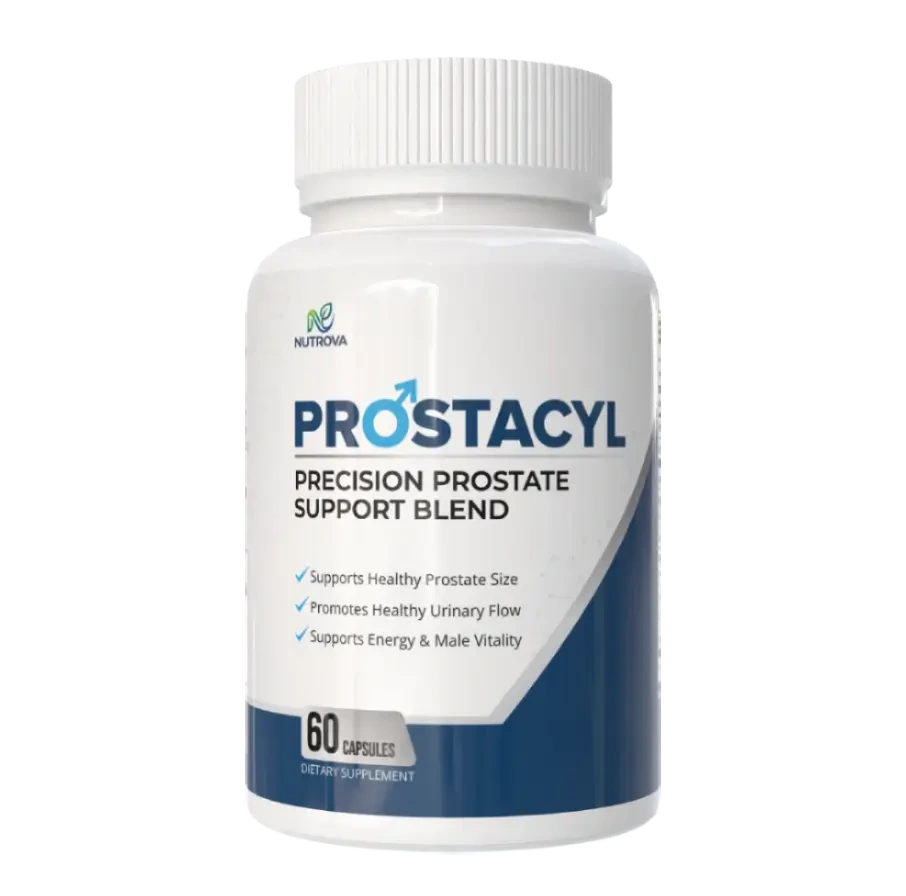
Nine actives, an amount printed against every one, and no proprietary blend. Two capsules a day, 60 to a bottle, with 60 days from purchase to change your mind.
One bottle $69 · six bottles $294 · 60-day money-back guarantee
Order Prostacyl On The Official WebsiteTwo capsules a day · 60 per bottle · lot PRO-26/GE-3008
Reading the 50 mg row on this bottle
A row that says “(leaf)” and then a number is doing something useful, even when the news it carries is unwelcome. Plenty of labels write “Nettle Extract” and stop, which leaves a buyer guessing at the one detail that decides whether the research applies. This one commits.
Set that beside the research and the gap is easy to hold in the head.
| What the panel prints | What the trials ran | The gap |
|---|---|---|
| Nettle Extract (leaf) | Nettle root, in every BPH trial in the literature | A different tissue, carrying a different set of compounds |
| 50 mg per two-capsule serving | Hundreds of milligrams of root extract a day | Several times over, before the plant part is even considered |
| Plant part named, extract ratio left open | Root extracts carrying their own marker standardisation | A second reason the two weights are hard to line up |
| One ingredient of nine on a printed panel | Usually one of two, given alongside saw palmetto fruit | The trials tested a pairing rather than nettle alone |
The left-hand column is read off the label artwork. The middle column is what the published studies used, not a prediction about this capsule.
Each line of that table widens the distance a little, and they are independent of one another. Fix the plant part and the weight is still short. Raise the weight and the plant part is still the wrong one. That is why this is the fairest single criticism anyone can make of this formula, and why it is stated on the ingredients page as well as here rather than tucked into small print.
What the leaf is not being accused of
The criticism above is a narrow one, and it is worth marking its edges.
- Not inert. Nettle leaf has a long traditional record and a research literature of its own, reviewed in the companion paper cited below. That literature is about other outcomes, so it cannot be borrowed to support a prostate row.
- Not a safety problem. The diuretic reputation nettle carries comes from animal work rather than human trials, which makes it theoretical in people. Anyone on a water tablet or a blood pressure medicine should put the bottle in front of their prescriber; the side effects page treats that at length.
- Not concealed. The plant part is in brackets on the front of the panel, where anybody can read it, and the weight is printed beside it.
Four changes that would line this row up
It is easy to criticise a row and harder to say what would satisfy the criticism. Four changes would do it, in descending order of importance:
- Root instead of leaf. Every controlled trial in this indication used the root, so this single substitution does more than the other three together.
- An amount in the hundreds of milligrams. The studied range sits far above 50 mg, and a formula carrying nine actives has to find that room somewhere.
- A standardisation marker. Root extracts in the literature are described by what they are standardised to, which is what makes two products comparable at all.
- A declared pairing. The strongest root evidence comes from fixed combinations with saw palmetto. This panel already carries saw palmetto at 300 mg, so the pairing is half built.
The fourth is the interesting one, because it is the only change this bottle is already most of the way towards. The saw palmetto row is dosed at almost exactly the amount its own trials standardised on, and what those trials found is a question of its own.
How much weight one row out of nine should carry
Proportion matters here, and a post about a single ingredient is the easiest place in the world to lose it. Nettle is 50 mg on a panel where saw palmetto is 300 mg and pygeum africanum is 200 mg. It is the seventh-largest of nine printed amounts, not the engine of the formula.
Pygeum is where this label is at its strongest: 200 mg against a researched 100 mg a day, in the one ingredient on the panel whose pooled result across eighteen trials is genuinely encouraging. Saying that plainly is the same discipline as saying the nettle is the wrong part of the plant.
So the reasonable way to carry this is as one entry on a ledger. The supplement facts page reproduces all nine rows, the pricing page puts the packs beside the cost a day, and the reviews page handles the distributor’s own figures with their limits attached.
Four questions worth asking of any nettle row
None of this is specific to one brand. Nettle turns up on a large share of the prostate shelf, and the same four questions sort the labels quickly.
- Does the label say root, leaf or aerial parts? If it says nothing, the row cannot be checked against any trial.
- How many milligrams, and of extract or of dried herb? Those are two different quantities and the difference can be tenfold.
- Is a standardisation marker given? Root extracts in the trials are described that way.
- Is saw palmetto in the same formula, as it was in the combination studies, and at what amount?
On this bottle the answers run: leaf, 50 mg of extract, no marker given, and yes at 300 mg. Two of the four go the right way, and the other two are the reason the 60-day window on the guarantee page is worth understanding before a first order rather than after a third bottle.
A dietary supplement for healthy men of 18 and over. Not a medicine, and not FDA-approved, because nothing in this category is. The three lines printed on the bottle cap everything said about it: healthy prostate size, healthy urinary flow, energy and male vitality. No argument about root or leaf changes that ceiling. Symptoms are worth having assessed once, and a separate article covers that properly.
References
- Chrubasik JE, Roufogalis BD, Wagner H, et al. A comprehensive review on the stinging nettle effect and efficacy profiles. Part II: urticae radix. Phytomedicine. 2007;14(7-8):568-79. PMID 17509841. https://pubmed.ncbi.nlm.nih.gov/17509841/
- Chrubasik JE, Roufogalis BD, Wagner H, et al. A comprehensive review on nettle effect and efficacy profiles, Part I: herba urticae. Phytomedicine. 2007;14(6):423-35. PMID 17493795. https://pubmed.ncbi.nlm.nih.gov/17493795/
- Schottner M, Gansser D, Spiteller G. Lignans from the roots of Urtica dioica and their metabolites bind to human sex hormone binding globulin (SHBG). Planta Med. 1997;63(6):529-32. PMID 9434605. https://pubmed.ncbi.nlm.nih.gov/9434605/
- Lopatkin N, Sivkov A, Walther C, et al. Long-term efficacy and safety of a combination of sabal and urtica extract for lower urinary tract symptoms - a placebo-controlled, double-blind, multicenter trial. World J Urol. 2005;23(2):139-46. PMID 15928959. https://pubmed.ncbi.nlm.nih.gov/15928959/