Prostacyl Official Website › Blog › When To See A Doctor
When Urinary Symptoms Need A Doctor, Not A Supplement
Every argument this website makes about doses assumes one question has already been settled by somebody who can examine you. A year of capsules is an expensive way to find out what a twenty-minute appointment would have told you in week one.
- Urinary symptoms have several possible causes, and an enlarged prostate is a conclusion rather than a starting point.
- An initial assessment is short: a history, a symptom score, a urine test, an examination and a conversation about PSA.
- Blood in the urine, an inability to pass urine, or fever with pain are reasons to be seen quickly rather than to start a capsule.
- A symptom score taken before anything starts is the only way to judge whether anything changed.
- Saw palmetto does not appear to affect a PSA reading, so that is not a reason to avoid either the test or the conversation.
The pattern most men describe
It starts with the nights. One trip becomes two, and two becomes routine. Then the stream takes a moment longer to begin than it used to, the whole business takes longer than it should, and there is a lingering sense of not being quite finished.
That cluster has a name in the clinic: lower urinary tract symptoms. Most men who develop it in their fifties and sixties have benign prostatic enlargement behind it, and MedlinePlus sets out the ordinary version in plain language.
It is common, it is not dangerous in itself, and it is among the most treatable things in men’s health once somebody has looked. The trouble is the last clause.
Enlarged prostate is a conclusion, not a symptom
The assumption running through this entire shelf is that a man with these symptoms has an enlarged prostate. Often he does, and often the alternatives matter.
The same cluster of symptoms has several other sources:
- A urinary tract infection, which brings urgency and frequency.
- Poorly controlled diabetes, which brings volume and thirst.
- An overactive bladder, which brings urgency without obstruction.
- A urethral stricture, which gives a poor stream in a man whose prostate is entirely normal.
- Several common medicines, which produce all of it on their own.
- A handful of less common causes that need finding rather than waiting.
Sorting between those is not something a supplement label or a search engine can do. It is what an examination is for, and it is quick.
What an initial assessment actually involves
The imagined version is what puts people off. What the American Urological Association’s guideline describes as an initial work-up is short, mostly conversation, and usually done in a single visit. The 2026 revision keeps the same shape.
| Step | What it involves | What it is there to sort out |
|---|---|---|
| History, including every medicine | A conversation about the pattern, the timing and the fluid | Some common medicines make these symptoms worse on their own |
| A structured symptom score | Seven questions about the last month, each scored 0 to 5 | Turns a vague complaint into a number you can repeat later |
| Urinalysis | A dipstick, usually on the spot | Infection, blood, glucose and protein |
| Physical examination | The abdomen, and a digital rectal examination | Size and texture of the gland, and a full bladder |
| A conversation about PSA | A blood test, discussed before it is taken rather than after | Whether the test is useful for you, and what a result would mean |
| Flow rate or post-void residual, where indicated | Two simple measurements done in the clinic | How much is actually left behind after passing urine |
The shape of an initial assessment as the guideline describes it. Not every step applies to every man, and the order varies by clinic.
Four of those six steps are talking and a dipstick, and the examination takes under a minute. Most men come out of it with reassurance, a symptom score and a plan that may well involve doing nothing for a while.
What “doing nothing for a while” actually means
Watchful waiting is a real plan with a name, not a brush-off. For mild symptoms that are not bothering a man much, the guideline treats monitoring plus lifestyle adjustment as an appropriate first option, with a review to see whether anything has changed.
The signs that should not wait
Most of this is unhurried. A short list is not.
| What you have noticed | What it commonly turns out to be | How soon it is worth raising |
|---|---|---|
| Getting up once or twice at night, a slower stream, coming on over years | The ordinary pattern of benign prostatic enlargement | At a routine appointment |
| Blood in the urine, at any age | Several possible causes, and some of them need investigating | Promptly, even if it happens once |
| Unable to pass urine at all, with a painful lower abdomen | Acute urinary retention | The same day, as an emergency |
| Fever, chills or pain in the back or between the legs with urinary symptoms | A possible infection of the urinary tract or prostate | The same day |
| New symptoms under 50, or a change over weeks rather than years | A pattern that does not fit the usual picture | Promptly |
Adapted from the public information cited below. It is a guide to urgency, not a way to work out which of these applies to you.
Being unable to pass urine at all with a painful, swelling lower abdomen. Blood that is visible in the urine. Fever or chills alongside urinary symptoms. Severe pain in the back, the lower abdomen or between the legs. None of those is a reason to open a bottle of anything.
Why the symptom score is worth doing first
The seven-question score is the most useful thing a man takes away from a first appointment, precisely because it is a number.
Urinary symptoms swing on their own from week to week, and in the placebo arms of trials in this field a substantial share of men improve over a year on nothing at all.
So “I think it is a bit better” after eight weeks of capsules is not evidence about the capsules. A score of 18 in March and 13 in May is at least a measurement, and it is the same instrument the trials used.
How to make that work in practice:
- Ask for the score sheet at the appointment and keep a copy. It is seven questions and takes two minutes.
- Write down the date and the total. Nothing else is needed.
- Repeat it at eight weeks and at twelve, at roughly the same time of day.
- Count night-time trips separately for one week at each point. That is the symptom easiest to count accurately.
- Change one variable at a time, so that a change has only one candidate explanation.
What to say about a supplement, and what not to worry about
Two conversations get tangled here, and only one of them is a real concern.
The real one is simple: tell whoever is treating you what you take, and take the bottle or a photograph of the panel with you. Nine actives with printed amounts is far easier for a clinician to assess than a brand name, and the panel is reproduced in full if the bottle is at home. If you take an anticoagulant or an antiplatelet medicine, say so specifically.
The one that is not real is the PSA myth. It is widely repeated that saw palmetto masks a PSA reading and could hide something. The pre-specified analysis inside the CAMUS trial, which pushed men all the way to 960 mg a day, looked for exactly that and found serum PSA no different from placebo. NCCIH says the same.
The myth has a cost. A man who believes his supplement will distort the test has a reason to avoid it, and that is worse than any interference the evidence has been able to find.
Prostacyl is for after the appointment, not instead of it
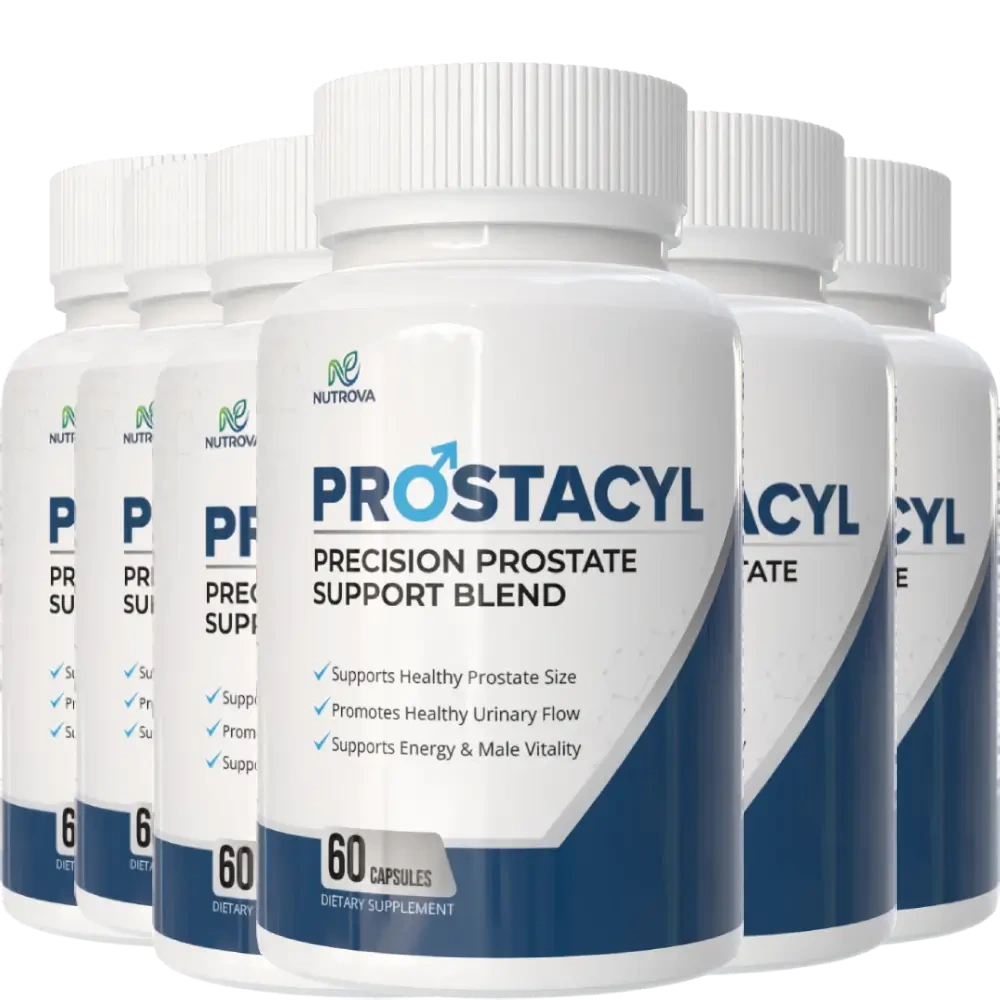
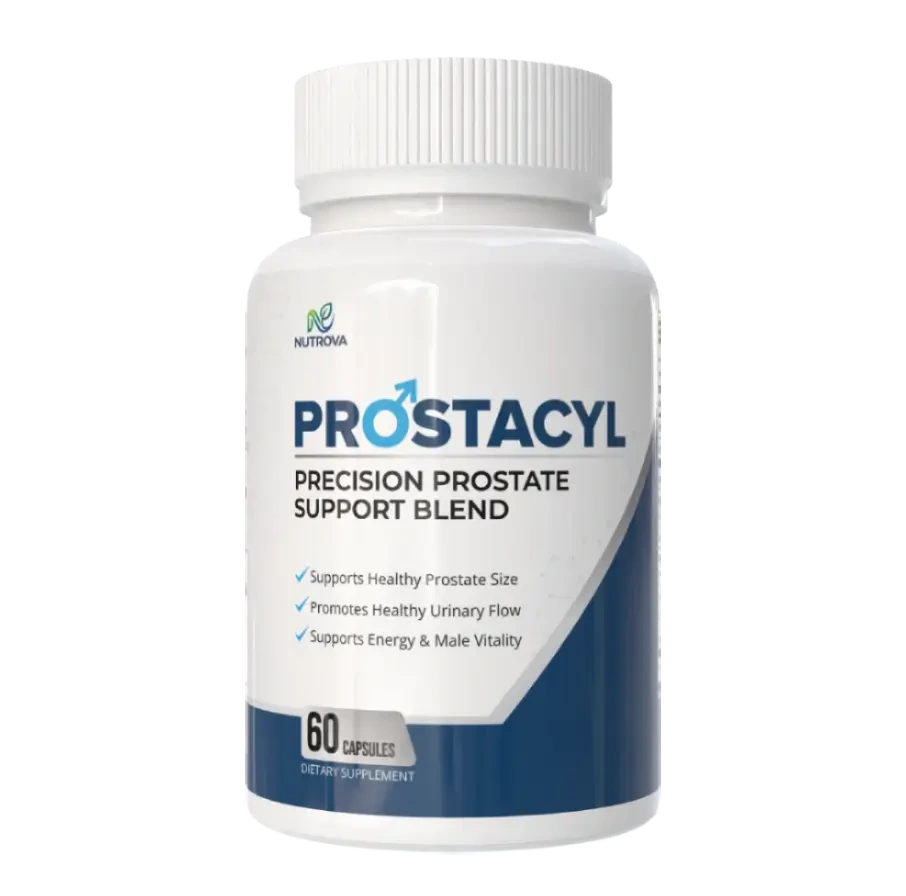
Nine actives with every amount printed, two capsules a day, and 60 days from purchase to change your mind. The bottle supports normal prostate and urinary function; it does not answer the question an examination answers.
One bottle $69 · six bottles $294 · 60-day money-back guarantee
Order Prostacyl On The Official WebsiteTwo capsules a day · 60 per bottle · lot PRO-26/GE-3008
Six things that change these symptoms and cost nothing
These come up in every guideline as first-line advice, they are free, and several of them work faster than anything sold in a capsule.
- Move the fluid earlier. Drink normally through the day and taper in the two to three hours before bed. Most men who halve their night-time trips do it here.
- Look at caffeine and alcohol. Both irritate the bladder and both act as diuretics. An evening pint and a late coffee are the two commonest causes of a bad night.
- Read the labels in the medicine cupboard. Decongestants, some antihistamines and a number of prescription medicines with anticholinergic effects make these symptoms worse. Diuretics taken in the evening do it by a different route.
- Take your time, and go again. Waiting half a minute and passing urine a second time empties the bladder better than straining does, and straining helps nothing.
- Treat constipation. A loaded rectum presses on the bladder and the effect is immediate once it is dealt with.
- Keep moving and keep weight in check. Both track with symptom severity across the observational literature, and both help several other things at the same time.
If those six change nothing over a month, that is information worth bringing to an appointment.
Keeping a week’s record before an appointment
A frequency-volume chart is the unglamorous tool that makes a first appointment twice as productive, and it needs a notepad and three days.
What goes on it:
- The time of every trip to the bathroom, day and night.
- A rough estimate of how much, each time.
- What you drank and when, including tea, coffee and alcohol.
- Three days is enough. A week is better.
- Take it with you, on paper.
It separates a man who passes small volumes very often from a man who passes normal volumes at night because he drinks two litres after eight o’clock. Those two need different advice, and no capsule distinguishes between them.

Where a supplement legitimately fits
None of this is an argument that a prostate supplement is pointless. It is an argument about the order things happen in.
After an assessment, with a symptom score on file, a man told his symptoms are mild to moderate and that monitoring is reasonable has a real decision to make. Taking something that supports normal prostate and urinary function while he watches it is a defensible choice, and it is exactly the space the three claims on this bottle describe.
What this desk will not do is pretend the capsule is the first step. Three other articles here work through the doses at length — the nettle is the wrong plant part, the pumpkin seed is the form that failed, the lycopene row needs dividing — and every one of those arguments assumes the buyer already knows what he is treating.
So: get it looked at once. Then read the ingredients page, weigh the nine amounts against the research beside them, and decide with a number in your hand rather than an impression.
Prostacyl is a dietary supplement for men of 18 and over in good health, with no FDA approval, and it is not intended to diagnose, treat, cure or prevent any disease — benign prostatic enlargement, prostatitis and prostate cancer included. Nothing written above can tell you what is causing your symptoms, and none of it stands in for an examination.
References
- Lerner LB, McVary KT, Barry MJ, et al. Management of Lower Urinary Tract Symptoms Attributed to Benign Prostatic Hyperplasia: AUA Guideline Part I - Initial Work-up and Medical Management. J Urol. 2021;206(4):806-817. PMID 34384237. https://pubmed.ncbi.nlm.nih.gov/34384237/
- Goueli R, Badlani GH, Welliver C, et al. Management of Lower Urinary Tract Symptoms Attributed to Benign Prostatic Hyperplasia: AUA Guideline (2026) Part I: Presentation and Evaluation. J Urol. 2026;216(2):143-151. PMID 42095481. https://pubmed.ncbi.nlm.nih.gov/42095481/
- MedlinePlus. Enlarged Prostate (BPH). Bethesda (MD): U.S. National Library of Medicine, National Institutes of Health. https://medlineplus.gov/enlargedprostatebph.html
- Andriole GL, McCullum-Hill C, Sandhu GS, et al. The effect of increasing doses of saw palmetto fruit extract on serum prostate specific antigen: analysis of the CAMUS randomized trial. J Urol. 2013;189(2):486-92. PMID 23253958. https://pubmed.ncbi.nlm.nih.gov/23253958/
- National Center for Complementary and Integrative Health. Saw Palmetto: Usefulness and Safety. https://www.nccih.nih.gov/health/saw-palmetto